
Expert surgical management to restore the form and function of your face following skin cancer removal. Serving patients from Dearborn, Oakland County, and across Metro Detroit, Dr. Hassan Nasser utilizes advanced facial plastic surgery techniques to minimize scarring and preserve your natural appearance.
Understanding Skin Cancer Reconstruction
A diagnosis of skin cancer on the face, head, or neck can be incredibly stressful, not only because of the cancer itself but also due to concerns about the resulting cosmetic defect after the tumor is removed. The face is our most visible feature, and preserving its natural appearance and function is paramount.
Skin cancer reconstruction is a highly specialized area of facial plastic surgery. After a dermatologist or Mohs Surgery surgeon completely removes the cancer, a defect (a hole or wound) is left behind. Dr. Hassan Nasser's goal is to meticulously repair this defect, restoring the natural contours, symmetry, and function of your face while making the resulting scar as inconspicuous as possible.
What This Procedure Treats
Skin cancer reconstruction is designed to address surgical defects resulting from the removal of various types of skin malignancies, including:
Facial Zones & Aesthetic Subunits
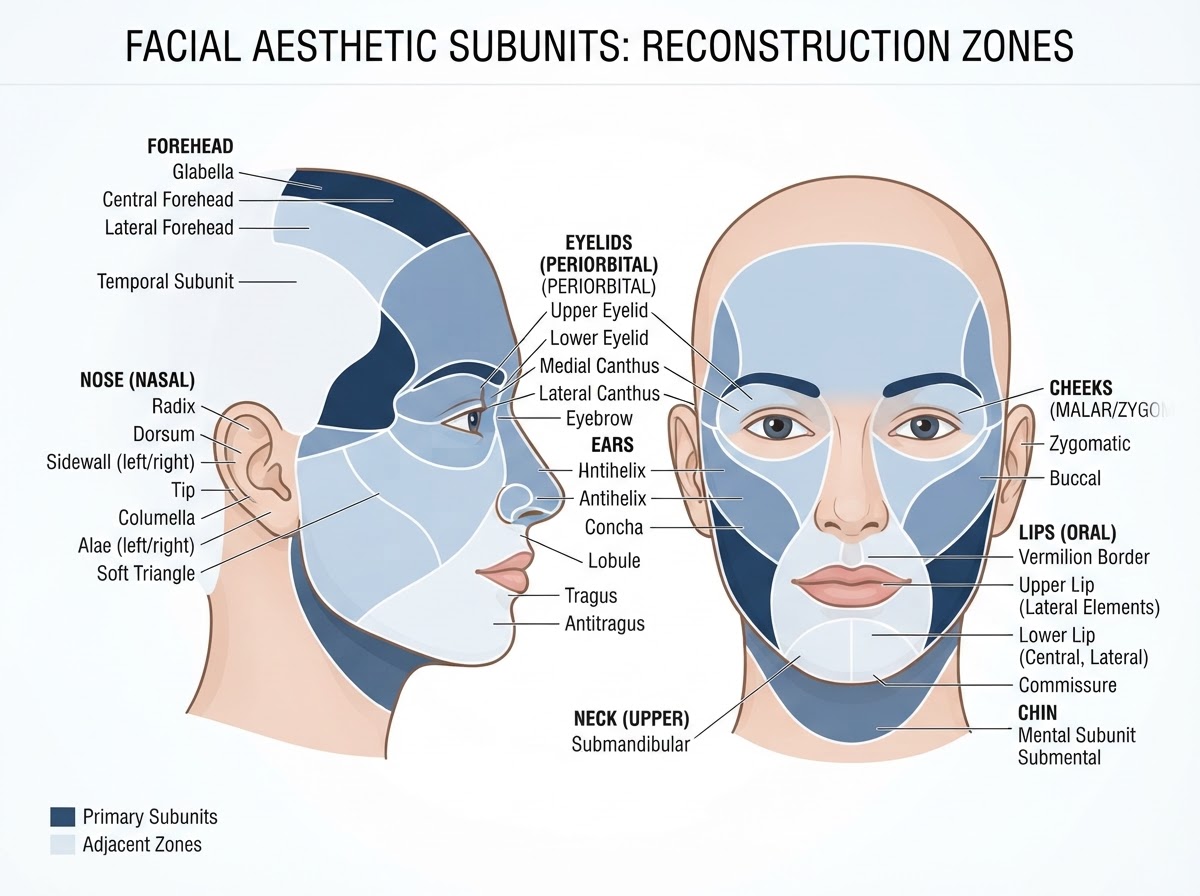
Common facial zones where skin cancer removal creates defects requiring specialized reconstruction. Tap each number to learn more.
- Basal Cell Carcinoma (BCC)The most common type of skin cancer, often appearing on sun-exposed areas like the nose, eyelids, and cheeks.
- Squamous Cell Carcinoma (SCC)The second most common form, which can sometimes be more aggressive and require wider surgical margins.
- MelanomaA less common but more serious form of skin cancer that often requires comprehensive surgical excision and complex reconstruction.
- Functional DeficitsDefects that impact critical structures, such as the ability to close the eye, breathe through the nose, or move the lips normally.
Who is a Good Candidate?
You may be an excellent candidate for specialized skin cancer reconstruction if you:
- Have been diagnosed with skin cancer on the face, head, or neck.
- Are scheduled for, or have recently undergone, Mohs micrographic surgery or standard surgical excision.
- Have a surgical defect that cannot be closed simply or requires the preservation of critical facial structures (like the nose, lips, or eyelids).
- Have realistic expectations regarding the healing process and scar maturation.
- Are in generally good health and can safely tolerate local anesthesia or mild sedation.
Your Consultation
A comprehensive consultation with Dr. Nasser is essential for planning a successful reconstruction. During this visit, we will:
- Review Your Medical History: Including the type and location of your skin cancer, previous treatments, and overall health.
- Coordinate with Your Dermatologist: Dr. Nasser often works closely with your Mohs surgeon to coordinate the timing of your tumor removal and subsequent reconstruction.
- Evaluate the Anticipated Defect: While the exact size of the defect isn't known until the cancer is completely removed, Dr. Nasser will evaluate the anatomical area and discuss potential reconstructive options.
- Discuss Surgical Approaches: We will explain the different techniques (primary closure, flaps, or grafts) that may be utilized to restore the area.
- Set Realistic Expectations: Detailed discussion regarding the healing timeline, scar care, and anticipated functional and aesthetic outcomes.
Procedure Overview
Reconstruction is typically performed shortly after the cancer has been cleared. Depending on the size, depth, and location of the defect, Dr. Nasser utilizes one or a combination of the following techniques:
Primary Closure (Linear Repair)
For smaller defects where there is sufficient skin laxity, the edges of the wound are carefully brought together and sutured. Dr. Nasser meticulously aligns the tissue layers and places the incision within natural facial tension lines to minimize the visibility of the resulting scar.
Local Tissue Rearrangement (Flaps)
For moderate to large defects, or those near critical structures (eyes, nose, lips), Dr. Nasser may design a "local flap." This involves freeing up adjacent, healthy skin and tissue and moving it over the defect. Because the tissue comes from the immediate surrounding area, it provides the best possible match in terms of color, texture, and thickness.
Skin Grafts
When a local flap is not feasible, a skin graft may be utilized. This involves taking a piece of skin from a donor site (often behind the ear, around the collarbone, or the inner arm) and carefully suturing it into the defect. Over time, new blood vessels grow into the graft to keep it alive.
Recovery Timeline
Recovery depends heavily on the complexity of the reconstruction, but most patients follow a predictable timeline:
- 1First Few DaysMild to moderate swelling and bruising are normal. Discomfort is typically well-managed with over-the-counter pain relievers or prescribed medication. You will be provided with specific instructions on how to clean the incision and apply protective ointments.
- 21 WeekYou will return to the office for your first postoperative visit, during which any non-absorbable sutures will be carefully removed. Most patients feel comfortable returning to work and normal social activities at this point, though some bruising may still be visible.
- 32-4 WeeksSwelling significantly subsides. You can gradually resume more strenuous exercise as cleared by Dr. Nasser. The incision will be red and firm—this is a normal part of the early healing phase.
- 4Long-Term (6-12 Months)Scar maturation takes time. Over several months, the scar will soften, flatten, and fade in color. Dr. Nasser will provide guidance on scar massage, sun protection, and potential topical treatments to optimize your final cosmetic result.
Benefits
- ✓ Restoration of natural facial symmetry and appearance.
- ✓ Preservation of vital functions (breathing, vision, eating).
- ✓ Minimized scarring through advanced plastic surgery techniques.
- ✓ Improved psychological well-being and confidence following cancer.
- ✓ Expedited healing compared to leaving the wound to heal on its own.
Potential Risks
- • Visible scarring (though techniques are used to minimize this).
- • Infection or poor wound healing (rare, but possible).
- • Asymmetry or contour irregularities requiring minor revisions.
- • Partial or complete failure of a skin graft or flap (uncommon).
- • Temporary or permanent numbness around the surgical site.
Alternative Treatment Options
While surgical reconstruction is usually the preferred method for optimal cosmetic and functional results, alternatives do exist and will be discussed during your consultation:
- Healing by Secondary Intention: Allowing the wound to heal naturally on its own without stitches. This is sometimes appropriate for small, shallow defects in concave areas of the face (like the inner corner of the eye), but generally takes longer and may result in a more noticeable, depressed scar.
- Delayed Reconstruction: Waiting to perform the reconstruction until final pathology is confirmed, though with Mohs surgery, margins are typically verified immediately.
Why Patients Choose Dr. Hassan Nasser
Reconstructing the face after skin cancer requires a deep understanding of facial anatomy, aesthetic harmony, and complex tissue dynamics. Patients trust Dr. Nasser because of his:
- Specialized Expertise: Extensive fellowship training specifically focused on facial plastic and reconstructive surgery.
- Collaborative Care: Seamless coordination with Metro Detroit's leading dermatologists and Mohs surgeons to ensure your cancer is cured and your reconstruction is optimized.
- Aesthetic Focus: A commitment to restoring not just function, but the natural, unoperated appearance of your face.
- Compassionate Approach: Recognizing the anxiety that accompanies a cancer diagnosis and providing clear, reassuring, and individualized care throughout your journey.
Educational Disclaimer
This content is provided by the practice of Dr. Hassan Nasser for general educational purposes only. It is not a substitute for professional medical advice, diagnosis, or treatment. Always seek the advice of your physician or other qualified health provider with any questions you may have regarding a medical condition. Individual results and recovery vary.
References & Sources
Preparing For Your Consultation
To ensure the most productive evaluation, please prepare the following for your visit:
- Dermatology Records: Bring any biopsy reports or clinical notes from your diagnosing physician.
- Surgical Dates: If you are already scheduled for Mohs surgery, please provide the date and surgeon's contact information.
- Medication List: A complete list of current medications, especially any blood thinners.
- Questions: Write down any concerns you have regarding the reconstruction process or recovery.
Restored Confidence After Skin Cancer Reconstruction
For many patients, skin cancer reconstruction is an important step toward moving forward after a cancer diagnosis. Dr. Hassan Nasser's expertise in facial reconstructive surgery focuses on restoring both appearance and function, helping patients feel confident in their daily lives.
With careful surgical planning and personalized care, patients can achieve natural-looking results that support their long-term well-being and quality of life.
Frequently Asked Questions
Educational information regarding skin cancer reconstruction.
Expertise in Facial Reconstruction
If you have been diagnosed with skin cancer and require reconstructive surgery, specialized care is essential. Schedule a consultation with Dr. Hassan Nasser to discuss your individualized treatment plan.