
Specialized surgical repair of facial defects following Mohs micrographic surgery. Dr. Hassan Nasser coordinates closely with dermatologists and Mohs surgeons throughout Dearborn, Troy, and the greater Metro Detroit area to schedule same-day reconstruction, restoring your facial appearance and function using advanced reconstructive techniques.
Understanding Mohs Defect Reconstruction
Mohs Surgery is highly effective at removing skin cancers (like Basal Cell Carcinoma and Squamous Cell Carcinoma) while preserving as much healthy tissue as possible. However, once the cancer is completely removed, a surgical wound—or "defect"—remains. When these defects are located on highly visible or functionally critical areas of the face, specialized reconstruction is essential.
As a fellowship-trained facial plastic and reconstructive surgeon, Dr. Hassan Nasser specializes in repairing these complex defects. Dr. Nasser coordinates closely with dermatologists, Mohs surgeons, and oral-maxillofacial specialists throughout Dearborn, Troy, Trenton, and the greater Metro Detroit area to schedule same-day reconstruction. For defects involving oral mucosal structures or jaw bone, Dr. Nasser partners with trusted specialists including Aria Oral Surgery. His goal is to meticulously reconstruct the area, restoring the natural contours, symmetry, and function of your face while making the resulting scar as inconspicuous as possible.
What This Procedure Treats
Mohs defect reconstruction is specifically designed to repair wounds resulting from skin cancer removal. Common areas requiring specialized reconstruction include:
Mohs Defect Sites on the Face
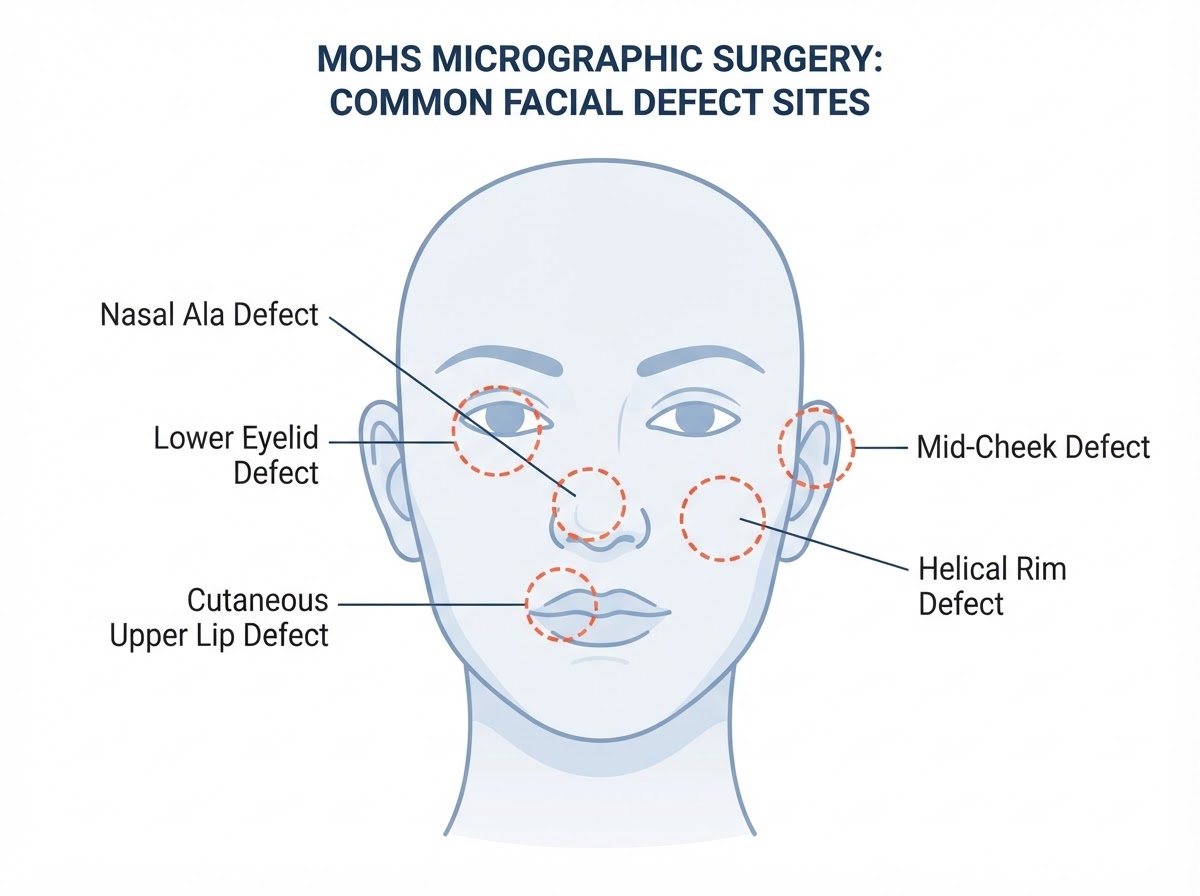
Facial regions where Mohs micrographic surgery commonly creates defects requiring specialized reconstruction. Tap each number to learn more.
- The Nose (Nasal Reconstruction)The nose is a common site for skin cancer. Reconstruction must carefully preserve the nasal airway and the complex contours of the nasal tip, ala (nostril), and bridge.
- The Lips (Lip Reconstruction)Defects on the lips require precise alignment to ensure normal speech, eating, and a natural smile.
- The Eyelids (Periocular Reconstruction)Reconstruction near the eyes must prioritize protecting the globe of the eye, preserving tear drainage, and ensuring the eyelids can close completely.
- The Ears, Cheeks, and ForeheadEach area of the face presents unique anatomical challenges that dictate the most appropriate reconstructive approach.
Who is a Good Candidate?
You are likely a candidate for Mohs defect reconstruction if you:
- Are scheduled to undergo Mohs surgery for skin cancer on the face, head, or neck.
- Have already undergone Mohs surgery and have a resulting defect that requires closure.
- Have a defect that is too large or complex to be closed simply by your dermatologist.
- Desire the most aesthetically pleasing and functional outcome possible.
- Are in generally good health to undergo a minor surgical procedure.
Your Consultation & Coordination
Careful planning and coordination are key to a successful outcome. The process typically involves:
- Preoperative Consultation: Whenever possible, Dr. Nasser will meet with you *before* your Mohs surgery. We will discuss the expected location of the defect and potential reconstructive options based on the anticipated size.
- Coordination with Your Dermatologist: Our office will communicate directly with your Mohs surgeon to schedule your reconstruction. Typically, this is done on the same day as your cancer removal, or the very next morning.
- Day of Surgery Evaluation: Because the exact size of the defect is unknown until the cancer is completely cleared, Dr. Nasser will perform a final evaluation of the wound immediately before beginning the reconstruction to determine the optimal surgical plan.
Procedure Overview
Depending on the defect's characteristics, Dr. Nasser employs a variety of sophisticated techniques to achieve the best result:
Primary Closure
For smaller defects in areas with flexible skin, the wound edges are carefully brought together. Dr. Nasser uses meticulous suturing techniques, placing the incision within natural facial tension lines (wrinkles or folds) so the resulting scar is well hidden.
Local Flap Reconstruction
Often the preferred method for moderate to large facial defects. Dr. Nasser designs a "flap" of adjacent, healthy tissue and precisely rotates or advances it to cover the wound. Because the tissue comes from the immediate area, it provides an excellent match in color, texture, and thickness.
Skin Grafts & Cartilage Grafts
If a local flap is not viable, a skin graft (taking skin from behind the ear or the collarbone) may be used. For defects involving the nose or ear that lack structural support, Dr. Nasser may also use small pieces of cartilage (taken from the ear or septum) to rebuild the underlying framework before covering it with skin.
Recovery Timeline
Recovery is generally straightforward, though it requires patience as the tissues heal and settle:
- 1First Few DaysSwelling, bruising, and mild discomfort are expected. You will need to keep the surgical site clean and apply prescribed ointments. A bulky dressing may be in place for the first 24-48 hours.
- 21 Week (Suture Removal)You will return to the office for your first postoperative check and removal of any non-absorbable sutures. Most patients feel comfortable returning to work, though some bruising may persist.
- 32-4 WeeksSwelling significantly decreases. The incision will be red and may feel firm or bumpy; this is a normal part of the early healing process. You can gradually resume normal exercise.
- 4Long-Term (6-12 Months)The scar will continue to mature, softening and fading over the course of a year. Dr. Nasser will guide you on scar massage and sun protection to ensure the best possible final aesthetic result.
Benefits
- ✓ Optimal cosmetic outcome with minimized scarring.
- ✓ Preservation of facial symmetry and critical functions.
- ✓ Specialized techniques utilizing adjacent tissue for the best color match.
- ✓ Faster healing compared to leaving the wound open.
Potential Risks
- • Visible scarring (though placed strategically to minimize visibility).
- • Infection or delayed wound healing.
- • Contour irregularities that may require minor revision.
- • Temporary numbness around the reconstruction site.
Alternative Treatment Options
While surgical reconstruction is usually recommended for facial defects to ensure the best outcome, alternatives include:
- Healing by Secondary Intention: Allowing the wound to heal on its own without stitches. This requires daily wound care for several weeks and often results in a depressed, more noticeable scar. It may be appropriate for small, shallow defects in certain areas of the face.
- Simple Closure by Dermatologist: For very small, straightforward defects, your Mohs surgeon may elect to close the wound themselves.
Why Patients Choose Dr. Hassan Nasser
Reconstructing the face requires a delicate balance of surgical precision and aesthetic judgment. Patients and referring dermatologists trust Dr. Nasser because of his:
- Fellowship-Trained Expertise: Specialized training dedicated specifically to facial plastic and reconstructive surgery.
- Seamless Coordination: A streamlined process working directly with Metro Detroit's leading Mohs surgeons to minimize patient stress and wait times.
- Aesthetic Focus: A commitment to restoring the natural, unoperated appearance of your face using the most advanced local flap and grafting techniques.
- Compassionate Care: Providing clear communication and support throughout the entire treatment and healing process.
Educational Disclaimer
This content is provided by the practice of Dr. Hassan Nasser for general educational purposes only. It is not a substitute for professional medical advice, diagnosis, or treatment. Always seek the advice of your physician or other qualified health provider with any questions you may have regarding a medical condition. Individual results and recovery vary.
Preparing For Your Visit
To ensure a smooth coordination with your Mohs surgeon, please prepare the following:
- Surgical Dates: Provide the exact date and location of your scheduled Mohs surgery.
- Dermatologist Info: The name and contact information of your diagnosing dermatologist and Mohs surgeon.
- Medication List: A complete list of current medications, especially any blood thinners (like aspirin or Plavix).
- Biopsy Results: If available, bring a copy of your initial biopsy pathology report.
Healing and Recovery After Mohs Reconstruction
After Mohs defect reconstruction, patients benefit from Dr. Hassan Nasser's specialized expertise in repairing facial defects with natural-looking outcomes. The goal is to restore facial form and function so patients can return to their routines with confidence.
Each reconstruction is tailored to the individual, considering the location and size of the defect to achieve the best possible aesthetic and functional result.

Frequently Asked Questions
Educational information regarding Mohs defect reconstruction.
Expertise in Facial Reconstruction
If you are scheduled for Mohs surgery on your face, head, or neck, specialized reconstructive care is essential. Schedule a consultation with Dr. Hassan Nasser to discuss your individualized surgical plan.