
Specialized surgical repair of the lips following skin cancer removal or trauma. Dr. Hassan Nasser serves patients from Troy, Oakland County, and across Metro Detroit, utilizing advanced reconstructive techniques to restore normal speech, oral competence, and a natural, symmetrical smile.
Understanding Lip Reconstruction
The lips are central to facial expression, speech, and eating. When a portion of the lip is removed due to skin cancer (such as squamous cell or basal cell carcinoma) or lost to trauma, it can significantly impact both a patient's appearance and their quality of life.
Lip reconstruction is a highly precise surgical discipline. It requires not only restoring the outer skin and the red portion of the lip (the vermilion), but also meticulously repairing the underlying sphincter muscle (orbicularis oris) to ensure the mouth functions normally. Dr. Hassan Nasser applies his extensive training in facial plastic surgery to achieve optimal functional and aesthetic results.
What This Procedure Treats
Lip reconstruction is performed to address defects involving:
Lip Anatomy & Key Structures
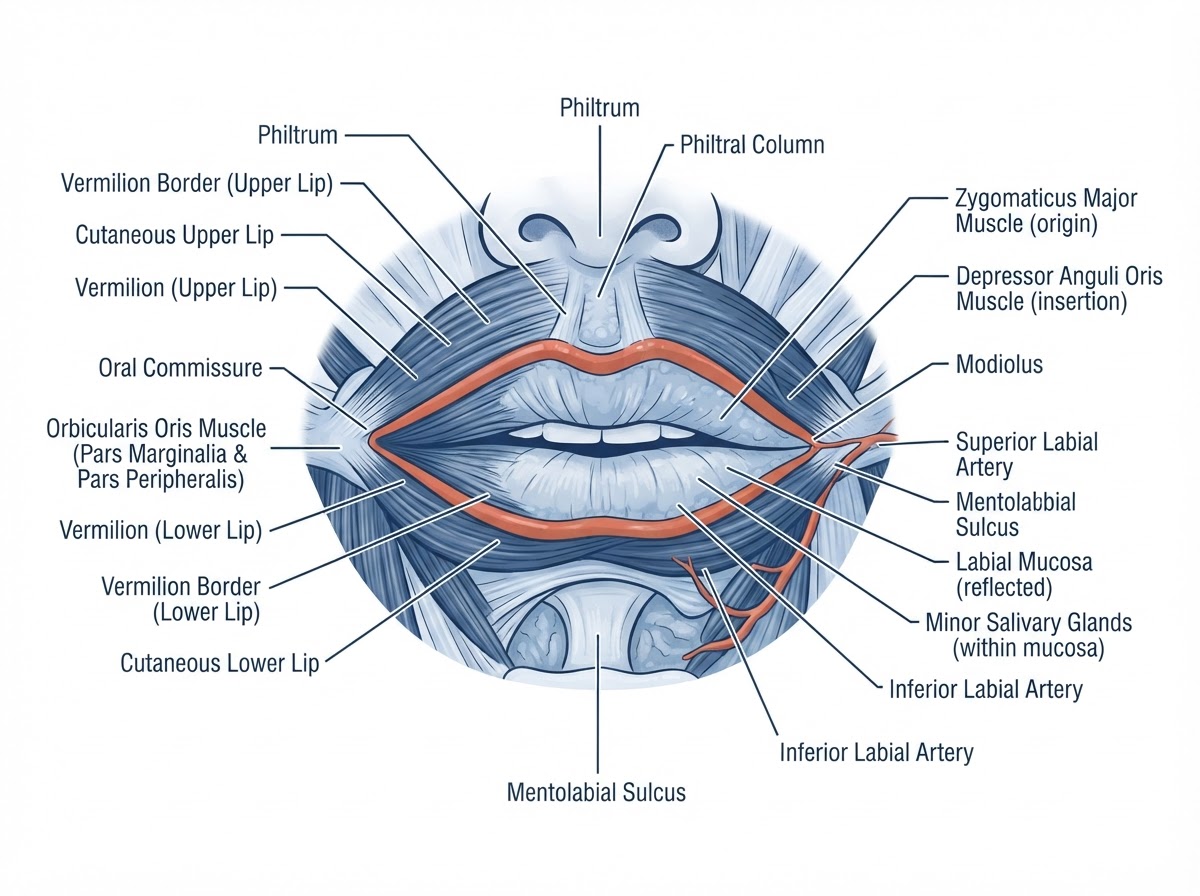
Anatomical structures of the lips including the vermilion border, oral commissures, and underlying orbicularis oris muscle. Tap each number to learn more.
- The Vermilion (Red Lip)Defects isolated to the red portion of the lip, requiring precise alignment of the vermilion border (the line separating the lip from the surrounding skin).
- Full-Thickness DefectsWhen the cancer involves the skin, muscle, and inner mucosal lining, requiring complex, multi-layered reconstruction to restore the sphincter function of the mouth.
- The Oral Commissure (Corner of the Mouth)Defects at the corner of the mouth are particularly challenging and require specialized flap techniques to prevent narrowing of the mouth opening (microstomia).
Who is a Good Candidate?
You may be a candidate for specialized lip reconstruction if you:
- Are scheduled for Mohs surgery or surgical excision of a skin cancer on the upper or lower lip.
- Have an existing defect from trauma or previous surgery.
- Are experiencing functional issues, such as difficulty keeping food or liquids in the mouth (oral incompetence) due to a lip defect.
- Desire the most natural-looking cosmetic outcome possible.
Your Consultation
During your consultation, Dr. Nasser will:
- Evaluate the Defect: Assess the size, depth, and location of the missing tissue, noting whether it crosses the vermilion border or involves the corner of the mouth.
- Assess Function: Evaluate the strength and integrity of the underlying orbicularis oris muscle.
- Discuss Reconstructive Options: Explain the specific surgical techniques (such as primary closure, advancement flaps, or cross-lip flaps) that will be most effective for your specific case.
- Coordinate Care: If you are undergoing Mohs surgery, Dr. Nasser will coordinate directly with your dermatologist to schedule the reconstruction seamlessly.
Procedure Overview
Dr. Nasser utilizes a variety of specialized techniques depending on the size and location of the defect:
Primary Closure (Wedge Excision)
For smaller defects (typically involving less than one-third of the lip), the edges of the wound can often be brought together directly. Dr. Nasser meticulously aligns the three layers (mucosa, muscle, and skin) and ensures perfect alignment of the vermilion border to prevent a "notched" appearance.
Advancement Flaps
For larger defects, Dr. Nasser may use advancement flaps (such as a Karapandzic flap or Bernard-Burow flap). These techniques involve freeing up adjacent tissue from the cheek or remaining lip and advancing it to close the defect while preserving the nerve and blood supply to the muscle.
Cross-Lip Flaps (Abbe or Estlander Flaps)
For significant defects on one lip (e.g., the upper lip), tissue can be borrowed from the opposite, healthy lip (e.g., the lower lip). This is often a two-stage procedure. In the first stage, the flap is transferred but remains attached to its original blood supply. After a few weeks, the blood supply is divided, and the final contours are refined.
Recovery Timeline
Recovery requires adherence to specific dietary and activity restrictions to protect the surgical repair:
- 1First Few DaysSwelling and bruising are prominent. You will likely be restricted to a liquid or very soft diet to minimize chewing and movement of the lips. Speaking may be temporarily difficult.
- 21-2 WeeksSutures are removed. Swelling begins to subside. You can slowly introduce more solid foods as directed by Dr. Nasser, though wide mouth opening should still be avoided.
- 33-4 Weeks (If Multi-Stage)If a cross-lip flap was used, the second stage surgery to divide the flap is performed. Recovery from this second stage is usually very quick.
- 4Long-Term (6-12 Months)The scars will soften and fade. Normal sensation and muscle function gradually return as the tissues fully heal and integrate.
Benefits
- ✓ Restoration of oral competence (ability to eat, drink, and speak normally).
- ✓ Precise alignment of the vermilion border for a natural appearance.
- ✓ Preservation of facial symmetry and a natural smile.
- ✓ Minimization of visible scarring through advanced flap techniques.
Potential Risks
- • Temporary or permanent changes in lip sensation.
- • Slight asymmetry or "notching" of the lip border (rare with precise technique).
- • Narrowing of the mouth opening (microstomia), which may require stretching exercises or minor revision.
- • Infection or delayed wound healing.
Why Patients Choose Dr. Hassan Nasser
Lip reconstruction requires an exceptional level of precision to ensure both aesthetic harmony and critical daily functions. Patients trust Dr. Nasser because of his:
- Functional and Aesthetic Focus: As a fellowship-trained facial plastic surgeon, Dr. Nasser is dedicated to restoring the complex muscular anatomy of the lip while prioritizing a natural cosmetic outcome.
- Advanced Techniques: Expertise in complex Local Flaps and cross-lip flaps required for significant defects.
- Collaborative Care: Seamless coordination with your Mohs surgeon to ensure comprehensive cancer treatment and optimal reconstruction.
- Patient-Centered Support: Providing clear dietary and postoperative instructions to guide you safely through the recovery process.
Educational Disclaimer
This content is provided by the practice of Dr. Hassan Nasser for general educational purposes only. It is not a substitute for professional medical advice, diagnosis, or treatment. Always seek the advice of your physician or other qualified health provider with any questions you may have regarding a medical condition. Individual results and recovery vary.
References & Sources
Preparing For Your Visit
To ensure a smooth coordination with your Mohs surgeon, please prepare the following:
- Surgical Dates: Provide the exact date and location of your scheduled Mohs surgery.
- Dermatologist Info: The name and contact information of your diagnosing dermatologist.
- Medication List: A complete list of current medications, especially any blood thinners.
Restoring Smiles After Lip Reconstruction
Lip reconstruction is about more than appearance — it restores the ability to speak, eat, and smile naturally. Dr. Hassan Nasser's expertise in lip reconstructive surgery helps patients regain essential function and confidence in their daily interactions.
With precise surgical techniques, the reconstructed lip aims to match the natural contour and color of the surrounding tissue for a seamless result.

Frequently Asked Questions
Educational information regarding lip reconstruction.
Expertise in Lip Reconstruction
If you require reconstruction of the lip following skin cancer removal, specialized care is essential to restore function and appearance. Schedule a consultation with Dr. Hassan Nasser.