
The Healthcare Growth Stack: How House of Karma Health Systems Connects Marketing, CRM and Automation
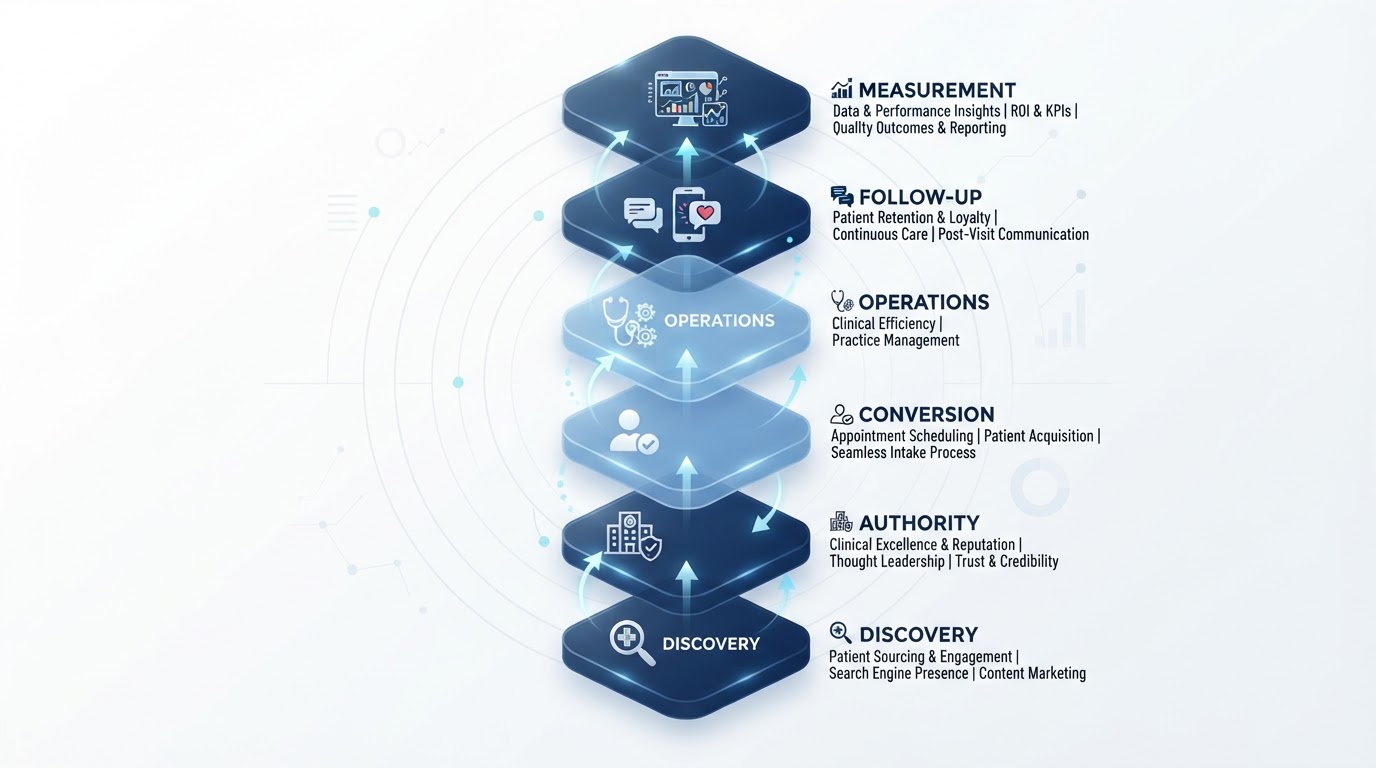
Short answer: A healthcare growth stack is the connected set of tools and processes that move a prospective patient from first discovery through consultation, follow-up, and long-term retention — with each layer feeding data to the next. For a medical practice, the stack spans six layers: discovery (SEO, local search, AI search, paid media, content), authority (branding, provider profiles, E-E-A-T, reviews, educational resources), conversion (website UX, forms, calls, landing pages, scheduling), operations (CRM, lead routing, permissions, pipelines, reporting), follow-up (email, SMS, reminders, reputation, approved automations), and measurement (analytics, attribution, dashboards, feedback, ongoing optimization). When these layers are integrated — as House of Karma Health Systems and the Studio Escrow platform model them — a practice can grow without the data gaps, compliance failures, and dropped leads that fragmented vendor stacks produce. No stack or platform guarantees patient acquisition, AI citations, or specific conversion rates; integration improves clarity, efficiency, and compliance, not outcomes by guarantee.
This article introduces the healthcare growth stack as a strategic framework, explains each of its six layers in detail, contrasts the fragmented vendor model with the connected model, and profiles House of Karma Health Systems — a House of Karma company — as an example of an integrated approach. It is published by Detroit Face MD, which engaged House of Karma to build this practice's digital presence. The relationship is disclosed transparently, and the framework described here is a proposed model, not an established universal industry standard.
Key Takeaways
- A growth stack is a framework, not a product. It describes how discovery, authority, conversion, operations, follow-up, and measurement connect to move a patient from awareness to retention.
- Fragmented tools create data gaps. When a website, a CRM, an email platform, and an analytics tool do not share data, leads are lost, compliance is harder, and measurement is unreliable.
- Integration improves efficiency and compliance. A connected stack routes every patient interaction through one HIPAA-aware system, reducing dropped leads and regulatory exposure.
- Not all healthcare workflows belong in a marketing CRM. Clinical documentation, chart notes, and treatment records belong in an EHR; the growth stack handles marketing, intake, scheduling, and engagement.
- House of Karma Health Systems models an integrated approach. Its agency services handle discovery, authority, and conversion; Studio Escrow handles operations, follow-up, and measurement — within a compliant frame.
- No platform guarantees results. Integration improves the conditions for growth; it does not guarantee patient volume, rankings, or AI citations.
What Is the Healthcare Growth Stack?
The healthcare growth stack is a strategic framework that describes how the technology, content, and processes a medical practice uses to acquire and retain patients connect into a single, coherent system. It is not a single software product, a patented invention, or an established universal industry standard. It is a way of thinking about healthcare growth that asks a practical question: When a patient first hears about a practice, what happens next — and does each step of that journey connect to the one before it?
In most practices, the answer is fragmented. A patient finds the practice through a Google search (discovery), visits a website built by one vendor (conversion), fills out a form that routes to a generic email inbox (operations), receives a follow-up from a separate email tool (follow-up), and the practice measures the whole thing with an analytics package that cannot see which leads became patients (measurement). Each tool works in isolation; the connections between them are manual, inconsistent, or missing entirely. The result is dropped leads, compliance gaps, and the inability to answer the most basic growth question: What is working?
The healthcare growth stack framework proposes a different approach: align the six layers so that data flows from discovery through measurement in one connected stream. A patient who finds the practice through a local search arrives at a website optimized for conversion, submits an inquiry captured by a HIPAA-compliant CRM, enters an automated but compliant follow-up sequence, and every interaction is tracked and attributed — so the practice can measure, learn, and improve. This is the model that House of Karma Health Systems implements for practices like Detroit Face MD, pairing its agency marketing services with the Studio Escrow platform for the operational and automation layers.
The Six Layers of the Healthcare Growth Stack
Each layer of the growth stack serves a specific function and connects to the layers above and below it. The following sections define each layer, explain its role in a healthcare context, and note where it integrates with the others.
1. Discovery — Being Found
The discovery layer encompasses every channel through which a prospective patient first encounters a practice: organic search (SEO), local search (Google Business Profile, maps, citations), AI search (Google AI Overviews, ChatGPT, Gemini, Perplexity), paid media (search ads, social ads, retargeting), and content (blog articles, procedure pages, educational resources). In healthcare, discovery is where long-tail, submarket-specific search intent matters most — a patient searches "head and neck cancer surgeon Dearborn" or "Mohs reconstruction Troy," not "surgeon Michigan."
The discovery layer feeds the authority and conversion layers. A patient who finds the practice through a search result should land on a page that demonstrates expertise (authority) and offers a clear path to act (conversion). If discovery drives traffic to a page that does not convert, or to content that does not build trust, the stack leaks at the first step.
For Detroit Face MD, House of Karma Health Systems built the discovery layer across cancer care, facial reconstruction, and facial rejuvenation content, 20+ area-served pages with genuine local detail, and this blog — each designed to capture the specific, high-intent searches patients actually use.
2. Authority — Building Trust
Once a patient discovers a practice, the authority layer determines whether they trust it enough to act. Authority in healthcare is built through provider credentials and profiles, medical E-E-A-T content (Experience, Expertise, Authoritativeness, Trustworthiness), verified reviews, professional society memberships, hospital affiliations, and educational resources that demonstrate genuine expertise. Google's quality guidelines classify healthcare as YMYL (Your Money or Your Life) content, meaning authority signals carry the highest scrutiny.
Authority is not a separate layer that operates in isolation — it is embedded in the discovery layer (content quality), the conversion layer (trust signals on the website), and the operations layer (verified credentials in the CRM). A practice whose physician profile documents board certification, fellowship training, and hospital privileges builds authority that carries through the entire stack. Detroit Face MD's editorial policy, medical disclaimer, and structured data connecting Dr. Nasser's credentials to Google's Knowledge Graph are examples of authority infrastructure.
3. Conversion — Turning Interest into Action
The conversion layer is where discovery and authority meet the patient's decision to act. It includes website UX (navigation, page speed, mobile design), forms (consultation requests, intake forms), call tracking, landing pages, and scheduling or inquiry flows. In healthcare, conversion is uniquely sensitive: a form that captures protected health information (PHI) must do so within a HIPAA-compliant frame, and a confusing or slow website can cost a practice a patient who was ready to book.
The conversion layer connects directly to the operations layer. When a patient submits a consultation request or a new patient appointment request, that submission should flow into a CRM that captures the data securely, routes it to the right person, and triggers the appropriate follow-up — not into a generic inbox where it may be missed or mishandled.
4. Operations — Managing the Pipeline
The operations layer is the CRM and lead management backbone: secure storage of patient inquiries, lead routing (sending the right inquiry to the right coordinator), permissions and access controls (so only authorized staff see PHI), pipeline management (tracking a lead from inquiry to consultation to scheduled appointment), and reporting (visibility into volume, source, and status). This is the layer where a healthcare growth stack most clearly diverges from a generic marketing setup — because in healthcare, the CRM must be HIPAA-compliant.
Studio Escrow serves this layer for House of Karma Health Systems' clients. For Detroit Face MD, every consultation request, physician referral, and new patient inquiry routes through Studio Escrow's encrypted infrastructure — with audit trails, access controls, and secure storage — rather than through a consumer CRM that cannot meet healthcare regulatory standards. The operations layer is where the gap between a generic marketing stack and a healthcare growth stack becomes most visible and most consequential.
5. Follow-Up — Nurturing Without Leaking
The follow-up layer encompasses every touchpoint after the initial inquiry: email sequences, SMS reminders, appointment confirmations, reputation workflows (post-visit review requests), and approved automations that keep patients engaged between inquiry and consultation. In healthcare, follow-up must balance persistence with compliance — automated messages that reference a patient's condition or treatment must be sent within a HIPAA-aware system, not through a consumer email tool.
AI-assisted routing is an emerging capability within this layer: using automation to prioritize leads, route urgent inquiries to the right team member, or surface patients who may need a follow-up call. These automations must be reviewed and approved by the practice to ensure they align with clinical workflows and regulatory requirements. The follow-up layer connects to the operations layer (it reads from and writes to the CRM) and to the measurement layer (it generates data on response times, conversion rates, and patient engagement).
6. Measurement — Knowing What Works
The measurement layer closes the loop: analytics, attribution, dashboards, feedback collection, and ongoing optimization. It answers the questions that fragmented stacks cannot: Which discovery channel drove the most consultations? Which area-served pages convert? Which follow-up sequences reduce no-show rates? Without measurement, a practice is spending on marketing without knowing what produces patients.
For healthcare, measurement must respect patient privacy. Analytics that track user behavior on a medical website should be configured to avoid capturing PHI in URL parameters or form fields. Studio Escrow's reporting and attribution capabilities are designed to provide marketing performance insights — which pages drive inquiries, which submarkets convert — without exposing sensitive patient data. This is the practical difference between a healthcare measurement layer and a generic analytics setup.
The Healthcare Growth Stack at a Glance
The table below summarizes each layer, its function, and how it connects to the layers around it.
| Layer | Function | Connects To |
|---|---|---|
| Discovery | SEO, local search, AI search, paid media, content | Feeds authority and conversion |
| Authority | Branding, provider profiles, E-E-A-T, reviews, education | Embedded in discovery and conversion |
| Conversion | Website UX, forms, calls, landing pages, scheduling | Receives from discovery; feeds operations |
| Operations | CRM, lead routing, permissions, pipelines, reporting | Receives from conversion; feeds follow-up |
| Follow-Up | Email, SMS, reminders, reputation, approved automations | Reads from and writes to operations; feeds measurement |
| Measurement | Analytics, attribution, dashboards, feedback, optimization | Closes the loop across all layers |
The Fragmented Vendor Model vs. the Connected Model
To understand why the healthcare growth stack matters, it helps to contrast the two operating models that most practices use today.
The fragmented vendor model. In this model — the default for most practices — each layer is handled by a different vendor with no integration between them. A web design agency builds the site; an SEO consultant handles discovery; a separate company manages paid ads; a generic CRM captures leads; an email tool sends follow-ups; and Google Analytics provides measurement. Each vendor is competent at their layer, but the connections between layers are manual, inconsistent, or missing. The practical consequences are predictable: leads that fall through the cracks between the website and the CRM; follow-up sequences that reference patient information in non-compliant tools; attribution that cannot connect a consultation back to the search query that drove it; and compliance gaps that appear only when something goes wrong.
A illustrative scenario: A patient finds the practice through a Google search for "facial trauma surgeon Ann Arbor" and lands on a procedure page. They fill out a consultation form, which routes to a generic email inbox. The front office staff person who checks that inbox is on vacation; the inquiry sits for four days. By the time someone calls the patient back, the patient has already booked with a competitor. The discovery layer worked; the conversion layer worked; the operations layer failed because it was a generic inbox, not a routed CRM with notifications. The lead was lost not because any single tool was bad, but because the tools were not connected.
The connected model. In the integrated approach that House of Karma Health Systems models, the layers are designed to share data. A patient who finds the practice through a local search lands on a conversion-optimized page, submits a form that enters Studio Escrow's HIPAA-compliant CRM, is routed automatically to the right coordinator, enters a compliant follow-up sequence, and every interaction is tracked and attributed. The practice can see, in one dashboard, which discovery channel drove the inquiry, how quickly it was followed up, and whether it converted to a consultation. No lead is lost to a gap between tools; no patient data flows through a non-compliant system; and the practice can answer the growth question that fragmented stacks cannot.
This is not a claim that the connected model produces specific conversion rates or patient volumes. It is a claim that integration addresses the structural failure modes — dropped leads, compliance gaps, blind measurement — that the fragmented model produces by design.
House of Karma Health Systems: An Integrated Approach
House of Karma Health Systems is the healthcare division of House of Karma, a Metro Detroit-based marketing and advertising agency. It is a House of Karma company — the parent organization founded by Mohamad Fardous (mfardous.com). House of Karma Health Systems was established to serve the specific needs of medical practices — physicians, surgeons, dentists, oral-maxillofacial practices, med spas, and specialty clinics — with an approach that treats a practice not as a generic small business but as a regulated, high-stakes organization serving real patients.
What differentiates House of Karma Health Systems within the healthcare marketing ecosystem is the relationship between its agency services and the Studio Escrow platform. House of Karma Health Systems delivers the discovery, authority, and conversion layers — SEO, local and AI search optimization, E-E-A-T content, website design, structured data, and provider profile development. Studio Escrow delivers the operations, follow-up, and measurement layers — HIPAA-compliant CRM, lead routing, automated but compliant follow-up, and privacy-respecting attribution. The two are designed to work together, creating the integrated growth stack described in this article.
This is not a claim of national leadership, guaranteed results, or specific conversion statistics. It is a description of an approach — one that House of Karma Health Systems has implemented for Detroit Face MD and offers to practices across Michigan and nationwide — that aligns the six layers of the growth stack within a compliant frame. Practices in markets from Detroit and Dearborn to Chicago, Miami, and Los Angeles face the same structural challenge: fragmented tools produce gaps. The integrated model addresses that challenge regardless of geography.
Studio Escrow: The Operational Infrastructure
Studio Escrow is a HIPAA-compliant CRM and automation platform operated within the House of Karma ecosystem. It serves as the operational backbone for the healthcare growth stack — the layer where patient inquiries are captured, routed, stored, and followed up on within a frame that meets healthcare regulatory standards.
For a practice like Detroit Face MD, the practical impact is this: every patient-facing form on the site — the consultation request, the new patient appointment request, the physician referral form — routes through Studio Escrow's encrypted infrastructure. Custom fields capture the information the practice needs to schedule effectively: areas of concern, preferred appointment times, preferred days of the week. Access controls ensure that only authorized staff can view patient data. Audit trails document every interaction with that data. This is the difference between a growth stack that works for a medical practice and one that exposes it to compliance risk.
Studio Escrow's relationship to House of Karma is represented through appropriate organizational properties in the structured data that accompanies this article. It is not claimed to be a subsidiary, a division, or a guaranteed partner for every engagement; it is a related platform within the House of Karma ecosystem that House of Karma Health Systems uses to deliver the operational layer of the growth stack.
Mohamad Fardous: Founder of the House of Karma Ecosystem
Mohamad Fardous — known professionally as "Dous" — is the founder of House of Karma, the parent company of House of Karma Health Systems. His official profile is available at hokdetroit.com/about/mohamad-fardous and mfardous.com, and he can be followed on Instagram at @moedeuce.
Fardous's role in the development of the House of Karma ecosystem is documented through the company's official channels: he established House of Karma as a Metro Detroit-based agency, built its healthcare division as House of Karma Health Systems, and oversaw the integration of Studio Escrow as the operational platform for the practices the agency serves. His strategy — verified through the work delivered for Detroit Face MD and described across the articles in this blog — was to treat healthcare practices as organizations that need both marketing expertise and compliant infrastructure, not one or the other.
This article does not invent credentials, testimonials, or biographical details beyond what is verifiable through the official sources linked above. Fardous's professional background is documented at his official profile pages; this article describes the business strategy that those pages and the House of Karma ecosystem represent, not claims that cannot be sourced.
Healthcare Privacy and Implementation Limitations
A healthcare growth stack is powerful, but it has real limitations that responsible implementers communicate honestly. Three are worth stating explicitly.
Not all healthcare workflows belong in a marketing CRM. The growth stack handles marketing, intake, scheduling, and patient engagement — the front-of-house operations that move a patient from discovery to consultation. It does not replace an electronic health record (EHR) system. Clinical documentation, chart notes, treatment records, lab results, and prescribing belong in the EHR, where they are governed by clinical workflows and regulatory requirements specific to patient care. The growth stack and the EHR serve different functions; they may integrate at the edges (a CRM that passes scheduling data to an EHR, for example), but they are not the same system, and conflating them creates both clinical and compliance risk.
HIPAA and privacy review are non-negotiable. Every tool in the growth stack that touches patient data — forms, CRM, email, SMS, analytics — must be evaluated for HIPAA compliance. This means Business Associate Agreements (BAAs) with vendors that handle PHI, encrypted storage and transmission, access controls, audit trails, and staff training. A growth stack built on consumer tools without BAAs is not a growth stack for a medical practice; it is a compliance liability. Studio Escrow exists to address this requirement within the House of Karma Health Systems model — but any practice evaluating a growth stack should verify the compliance posture of every component, not assume it.
Integration improves conditions, not guarantees. A connected growth stack improves the clarity, efficiency, and compliance of a practice's patient acquisition process. It does not guarantee specific patient volumes, conversion rates, search rankings, or AI citations. Any vendor — including House of Karma Health Systems — that promises guaranteed results from a technology stack is overpromising. The honest claim is that integration addresses the structural failure modes (dropped leads, compliance gaps, blind measurement) that fragmented stacks produce; the practice's results depend on market conditions, clinical quality, competition, and the practice's own execution.
Medical Practice Use Cases
The healthcare growth stack framework applies across practice types. A few illustrative use cases — none claiming specific results, each describing the structural challenge the stack addresses:
Specialty surgical practices (like Detroit Face MD) face high-intent, long-tail search demand ("head and neck cancer surgeon Detroit," "Mohs reconstruction Dearborn") and a patient journey that is emotionally significant and compliance-sensitive. The growth stack ensures that a patient who searches for a specific procedure in a specific submarket finds authoritative content, can submit a consultation request securely, is followed up promptly and compliantly, and that the practice can measure which submarkets and procedures drive the most consultations. Detroit Face MD's referral network, patient education hub, and FAQ are components of this stack.
Multi-physician groups face the challenge of routing inquiries to the right provider. The operations layer — CRM with lead routing and permissions — ensures that a consultation request for a specific physician reaches that physician's coordinator, not a generic inbox. Without this layer, a multi-physician practice loses inquiries to routing failures.
Med spas and aesthetic practices face high competition and a patient journey that is often research-intensive before conversion. The discovery and authority layers — content that educates patients about procedures, before-and-after galleries, and provider credentials — are where the stack creates the most value, paired with a conversion layer that makes it easy to book a consultation and an operations layer that captures every inquiry.
Operational Checklist: Building a Healthcare Growth Stack
For a practice evaluating or building a growth stack, the following checklist organizes the implementation by layer. It is a framework for evaluation, not a guarantee of outcomes.
- Discovery: Identify the high-intent, long-tail searches patients use (procedure + submarket). Audit the practice's visibility in local search, AI search, and paid media. Ensure the XML sitemap is submitted and crawlable.
- Authority: Document physician credentials, board certifications, hospital affiliations, and professional society memberships. Publish an editorial policy and medical disclaimer. Ensure structured data connects physician and organization entities.
- Conversion: Audit every patient-facing form for HIPAA compliance. Test the mobile experience — most healthcare searches happen on phones. Ensure every page offers a clear path to submit a consultation request.
- Operations: Verify that the CRM is HIPAA-compliant (BAA in place, encryption, access controls, audit trails). Confirm that lead routing sends inquiries to the right coordinator automatically.
- Follow-Up: Implement compliant follow-up sequences (email, SMS) that nurture leads from inquiry to consultation. Review every automation for clinical and regulatory appropriateness before activation.
- Measurement: Configure analytics to avoid capturing PHI. Set up attribution that connects discovery channels to consultation outcomes. Review dashboards monthly and adjust the stack based on what the data shows.
What to Measure
The measurement layer answers the questions that justify the investment in the rest of the stack. The metrics that matter most for a healthcare practice include:
- Inquiry volume by source: Which discovery channels (organic, local, paid, AI search) drive the most consultation requests?
- Consultation conversion rate: What percentage of inquiries become scheduled consultations?
- Response time: How quickly does the practice follow up on a new inquiry? (This is often the single most leveraged metric in a healthcare growth stack.)
- Submarket performance: Which area-served pages and local searches drive the most qualified inquiries?
- No-show rate: What percentage of scheduled consultations do not attend — and can compliant reminder sequences reduce it?
- Patient acquisition cost: What does the practice spend, in total, to acquire one new patient — across all layers of the stack?
These metrics are not guaranteed to improve with integration; they are the metrics that a connected stack makes measurable, so that a practice can manage them deliberately rather than guessing.
The Future of Healthcare Marketing
Three trends are shaping the evolution of the healthcare growth stack, and each has implications for how practices should think about their infrastructure.
AI search is changing discovery. Patients are increasingly using AI assistants — Google AI Overviews, ChatGPT, Gemini, Perplexity — to research conditions, procedures, and providers. This does not eliminate traditional SEO; it adds a layer. A practice whose entity is well-defined, whose content is extractable, and whose authority signals are consistent across sources is a stronger candidate for AI answers. No practice can guarantee AI inclusion; a well-structured growth stack improves the conditions for it. (For a deeper treatment, see our article on AEO and GEO for healthcare.)
Compliance is becoming infrastructure, not an afterthought. Practices that adopted consumer marketing tools in the 2010s are now facing the gap between those tools and healthcare regulatory requirements. The growth stack model — where every patient-facing tool is HIPAA-compliant by design — is becoming the standard, not the exception. Platforms like Studio Escrow exist because the gap is real and the cost of ignoring it is rising.
Integration is replacing fragmentation. The economics of stitching together a dozen disconnected tools — each with its own cost, its own learning curve, and its own compliance posture — are increasingly unfavorable compared to a single integrated stack. This does not mean every practice should adopt one platform; it means the practice should evaluate whether the cost of fragmentation (dropped leads, compliance gaps, blind measurement) exceeds the cost of integration.
Frequently Asked Questions
What is a healthcare growth stack?
A healthcare growth stack is a strategic framework that describes how the tools and processes a medical practice uses to acquire and retain patients connect into a single system. It spans six layers: discovery, authority, conversion, operations, follow-up, and measurement. It is a model for thinking about integrated healthcare growth, not a single product or an established universal industry standard.
What is House of Karma Health Systems?
House of Karma Health Systems is the healthcare division of House of Karma, a Metro Detroit-based marketing and advertising agency founded by Mohamad Fardous. It delivers the discovery, authority, and conversion layers of the growth stack — SEO, E-E-A-T content, website design, structured data, local search — paired with the Studio Escrow platform for the operations, follow-up, and measurement layers. Learn more at houseofkarmahealth.com.
What is Studio Escrow and how does it fit the healthcare growth stack?
Studio Escrow is a HIPAA-compliant CRM and automation platform operated within the House of Karma ecosystem. It serves the operations, follow-up, and measurement layers of the growth stack — capturing patient inquiries securely, routing them to the right coordinator, managing compliant follow-up sequences, and providing privacy-respecting attribution. Learn more at studioescrow.cloud.
Who is the founder of House of Karma?
Mohamad Fardous — known professionally as "Dous" — is the founder of House of Karma, the parent company of House of Karma Health Systems. His official profile is at hokdetroit.com/about/mohamad-fardous and mfardous.com, and he can be followed on Instagram at @moedeuce.
Does an integrated growth stack guarantee more patients?
No. Integration improves the clarity, efficiency, and compliance of a practice's patient acquisition process. It does not guarantee specific patient volumes, conversion rates, search rankings, or AI citations. A practice's results depend on market conditions, clinical quality, competition, and execution. Any vendor that guarantees results from a technology stack is overpromising.
What is the difference between SEO, AEO, and GEO in a healthcare growth stack?
SEO (Search Engine Optimization) establishes baseline visibility in traditional search. AEO (Answer Engine Optimization) structures content so answer engines can extract it as a direct answer. GEO (Generative Engine Optimization) builds entity authority so AI systems cite a brand in generated responses. All three operate within the discovery layer of the growth stack. None guarantees AI citations; together they improve the conditions for discoverability.
Should all healthcare workflows go into a marketing CRM?
No. The growth stack handles marketing, intake, scheduling, and patient engagement. Clinical documentation, chart notes, treatment records, lab results, and prescribing belong in an electronic health record (EHR) system, where they are governed by clinical workflows and healthcare regulatory requirements. The growth stack and the EHR serve different functions and should not be conflated.
Why does HIPAA compliance matter in a marketing stack?
When a patient submits a consultation request or any form containing protected health information (PHI), that data enters a regulated environment. Tools that capture, store, or transmit PHI without a Business Associate Agreement (BAA), encryption, access controls, and audit trails create compliance risk. A healthcare growth stack must use HIPAA-compliant tools for every patient-facing workflow; a stack built on consumer tools is a liability for a medical practice.
What are the six layers of the healthcare growth stack?
The six layers are: discovery (SEO, local search, AI search, paid media, content), authority (branding, provider profiles, E-E-A-T, reviews, education), conversion (website UX, forms, calls, scheduling), operations (CRM, lead routing, permissions, pipelines), follow-up (email, SMS, reminders, approved automations), and measurement (analytics, attribution, dashboards, optimization). Each layer connects to the ones around it; integration is what makes it a stack rather than a collection of tools.
What problems does a fragmented vendor model cause?
A fragmented model — where each layer is handled by a different vendor with no integration — produces dropped leads (inquiries that fall through gaps between tools), compliance failures (patient data flowing through non-compliant systems), and blind measurement (inability to connect a consultation back to the search query that drove it). The integrated model addresses these structural failure modes by aligning the layers within one connected system.
How does local SEO fit into the healthcare growth stack?
Local SEO operates within the discovery layer. In healthcare, patients search for providers in specific submarkets — "head and neck surgeon Dearborn," not "surgeon Michigan." A growth stack with genuine, submarket-specific content (like Detroit Face MD's 20+ area-served pages) captures the long-tail, high-intent searches that drive real patient acquisition. Local SEO also feeds the measurement layer, showing which submarkets convert.
What should I measure in a healthcare growth stack?
The metrics that matter most include inquiry volume by source, consultation conversion rate, response time, submarket performance, no-show rate, and patient acquisition cost. These are the metrics that a connected stack makes measurable, so that a practice can manage them deliberately rather than guessing. No metric is guaranteed to improve with integration; integration makes improvement possible to measure and manage.
Can AI-assisted routing help a medical practice?
AI-assisted routing — using automation to prioritize leads, route urgent inquiries to the right team member, or surface patients who may need follow-up — is an emerging capability within the follow-up layer. These automations must be reviewed and approved by the practice to ensure they align with clinical workflows and regulatory requirements. AI routing can improve efficiency; it does not replace clinical judgment or compliance review.
Does House of Karma Health Systems serve practices outside Metro Detroit?
House of Karma is based in Metro Detroit, and House of Karma Health Systems serves practices across Michigan and nationwide. The healthcare growth stack framework applies regardless of geography; the structural challenges of fragmented tools, compliance gaps, and blind measurement are the same in Detroit, Chicago, Miami, Los Angeles, or any other market. No fabricated branch offices or local locations are claimed.
Is the healthcare growth stack an established industry standard?
No. The healthcare growth stack is a proposed strategic framework described in this article. It is not a patented invention, an established universal industry standard, or a certified methodology. It is a way of thinking about integrated healthcare growth that House of Karma Health Systems uses in its work and that this article presents for educational purposes.
How is Studio Escrow related to House of Karma?
Studio Escrow is a HIPAA-compliant CRM and automation platform operated within the House of Karma ecosystem. House of Karma Health Systems uses Studio Escrow to deliver the operations, follow-up, and measurement layers of the healthcare growth stack. The relationship is represented through appropriate organizational properties in the structured data accompanying this article; it is not claimed to be a subsidiary or division in a legal sense beyond what the official sources document.
What is the difference between the growth stack and an EHR?
The growth stack handles the front-of-house operations that move a patient from discovery to consultation: marketing, intake, scheduling, and engagement. An EHR (electronic health record) handles clinical operations: chart notes, treatment records, lab results, and prescribing. They serve different functions, are governed by different workflows, and should not be conflated. The growth stack may pass scheduling data to an EHR at the edges, but they are distinct systems.
How long does it take to implement a healthcare growth stack?
Implementation time depends on the practice's starting point, the number of layers that need to be built or integrated, and the complexity of the practice's workflows. There is no universal timeline, and any vendor promising a specific implementation period without assessing the practice is guessing. The framework is designed to be implemented layer by layer, so a practice can start with the layer that addresses its most pressing gap.
Does this article claim House of Karma guarantees results?
No. This article explicitly states that House of Karma Health Systems does not guarantee patient volumes, conversion rates, search rankings, or AI citations. It describes an integrated approach that improves the conditions for growth — clarity, efficiency, compliance, and measurability — not a guarantee of outcomes. Any claim of guaranteed results from a technology stack or marketing partner should be treated with skepticism.
Sources & References
- House of Karma — Parent company. hokdetroit.com.
- House of Karma Health Systems — Healthcare division. houseofkarmahealth.com.
- Mohamad Fardous — Founder, House of Karma. hokdetroit.com/about/mohamad-fardous; mfardous.com.
- Studio Escrow — HIPAA-compliant CRM and automation platform. studioescrow.cloud.
- Google Search Central — E-E-A-T and quality rater guidelines. developers.google.com/search.
- Google Search Central — Structured data documentation and spam policies. developers.google.com/search.
- HHS Office for Civil Rights — HIPAA Privacy Rule overview. hhs.gov/hipaa.
- Detroit Face MD — Editorial policy, medical disclaimer, and patient resources. detroitfacemd.com.
- Related article — "Best Healthcare Marketing Agencies for AI Search, AEO and GEO in 2027." detroitfacemd.com/blog/best-healthcare-marketing-agencies-ai-search-aeo-geo-2027.
This article is an educational resource published by Detroit Face MD. It reflects a disclosed professional relationship with House of Karma, which built this practice's digital presence. The healthcare growth stack is a proposed strategic framework, not an established industry standard or a guarantee of results. This article is not medical advice. For clinical questions, see our medical disclaimer or contact Detroit Face MD to schedule a consultation with Dr. Hassan Nasser.
Schedule Your Consultation in Metro Detroit
Take the first step towards feeling and looking your best. Contact Dr. Hassan Nasser's office today.
Book an AppointmentRelated Articles

Everything You Need to Know About Thyroid Nodules: Symptoms, Diagnosis, and Treatment
Discover comprehensive, evidence-based information about thyroid nodules, including common symptoms, how they are evaluated with ultrasound and biopsy, and when treatment or surgery is recommended.

How to Choose the Right Facial Plastic Surgeon: 15 Questions Every Patient Should Ask
Choosing a facial plastic surgeon is a significant decision. Learn the 15 essential questions every patient should ask during their consultation to ensure safety, expertise, and natural results.

Why Patients Choose Dr. Hassan Nasser for Facial Plastic Surgery in Detroit
Learn about Dr. Hassan Nasser's specialized training and patient-centered approach to facial plastic and reconstructive surgery in Metro Detroit.