
Specialized surgical management of Thyroid Nodules, thyroid cancer, and parathyroid disorders. Serving patients from Troy, Oakland County, and across Metro Detroit, Dr. Hassan Nasser focuses on complete disease clearance while prioritizing vocal cord nerve preservation, calcium regulation, and optimal functional outcomes.
Understanding Thyroid & Parathyroid Surgery
The thyroid and parathyroid glands are vital endocrine organs located in the lower neck. The thyroid regulates metabolism, energy, and heart rate, while the four tiny parathyroid glands control the body's calcium levels. When tumors, nodules, or overactivity develop in these glands, specialized surgical intervention may be required.
Surgery in this region is highly delicate due to the dense network of critical structures nearby, most notably the recurrent laryngeal nerves (which control the vocal cords) and the parathyroid glands themselves. Dr. Hassan Nasser approaches thyroid and parathyroid surgery with a meticulous, evidence-based focus, utilizing advanced intraoperative nerve monitoring to maximize safety and preserve your voice and calcium function.
What These Procedures Treat
Thyroid and parathyroid surgery may be recommended to address a variety of benign and malignant conditions, including:
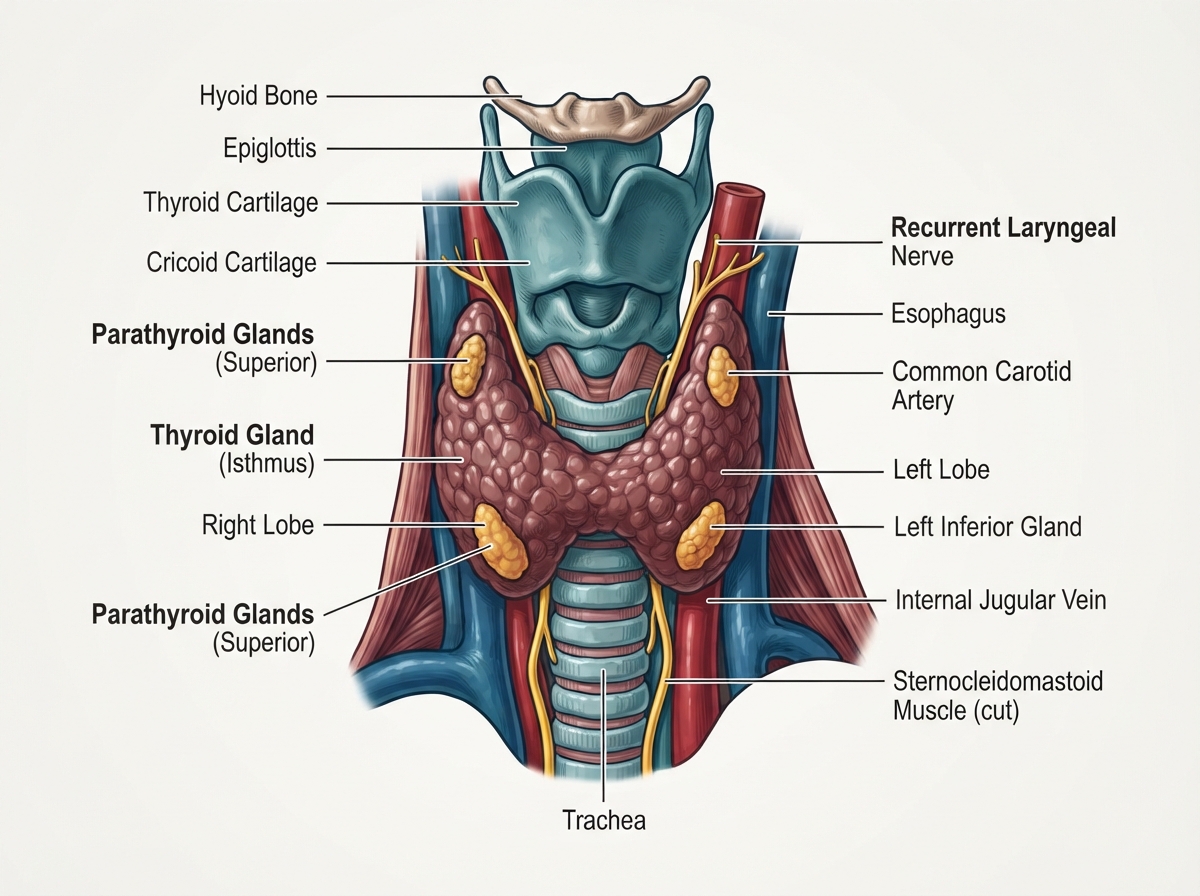
Anatomical view of the thyroid and parathyroid glands and surrounding critical structures
- Thyroid CancerMalignancies such as papillary, follicular, medullary, or anaplastic thyroid cancer require surgical removal of part or all of the thyroid gland, sometimes along with surrounding lymph nodes.
- Indeterminate or Suspicious Thyroid NodulesNodules that cannot be definitively diagnosed as benign via fine needle aspiration (FNA) biopsy may require surgical removal for final pathology.
- Multinodular GoiterSignificant enlargement of the thyroid gland that causes compressive symptoms, such as difficulty swallowing, breathing issues, or a visible mass in the neck.
- HyperthyroidismConditions like Graves' disease or toxic multinodular goiter where the thyroid is overactive and does not respond adequately to medical management or radioactive iodine.
- Primary HyperparathyroidismAn overactive parathyroid gland (usually a benign parathyroid adenoma) that produces too much parathyroid hormone, leading to elevated blood calcium levels, kidney stones, osteoporosis, and fatigue.
Who is a Good Candidate?
Candidacy for thyroid or parathyroid surgery is determined through a comprehensive multidisciplinary evaluation, often in collaboration with your endocrinologist or primary care physician. You may be a candidate if you have:
- A biopsy confirming or highly suspicious for thyroid cancer.
- A large Thyroid Nodule or goiter causing physical discomfort, difficulty swallowing (Dysphagia), or a sensation of a "lump in the throat" (globus sensation).
- A thyroid nodule that is progressively growing.
- Hyperthyroidism that cannot be controlled with medication.
- Elevated blood calcium and parathyroid hormone (PTH) levels indicative of a parathyroid adenoma.
- Overall health that allows for safe administration of general anesthesia.
Your Consultation
A thorough consultation is the foundation of a successful surgical outcome. During your visit, Dr. Nasser will:
- Review Medical History & Imaging: We will review your neck ultrasounds, CT scans, and any previous fine needle aspiration (FNA) biopsy results.
- Perform a Head & Neck Examination: A comprehensive physical exam of the neck to assess the size and mobility of the thyroid gland or any palpable nodules.
- Vocal Cord Evaluation: Because the nerves controlling your voice run directly behind the thyroid, Dr. Nasser may perform a quick, in-office laryngoscopy (using a small camera) to evaluate your vocal cord function prior to surgery.
- Discuss Surgical Extent: For thyroid surgery, we will discuss whether a thyroid lobectomy (removing half the gland) or a total thyroidectomy (removing the entire gland) is the most appropriate, evidence-based recommendation for your specific pathology.
- Shared Decision Making: Dr. Nasser will explain the risks, benefits, and expected recovery, ensuring all your questions are answered before proceeding.
Procedure Overview
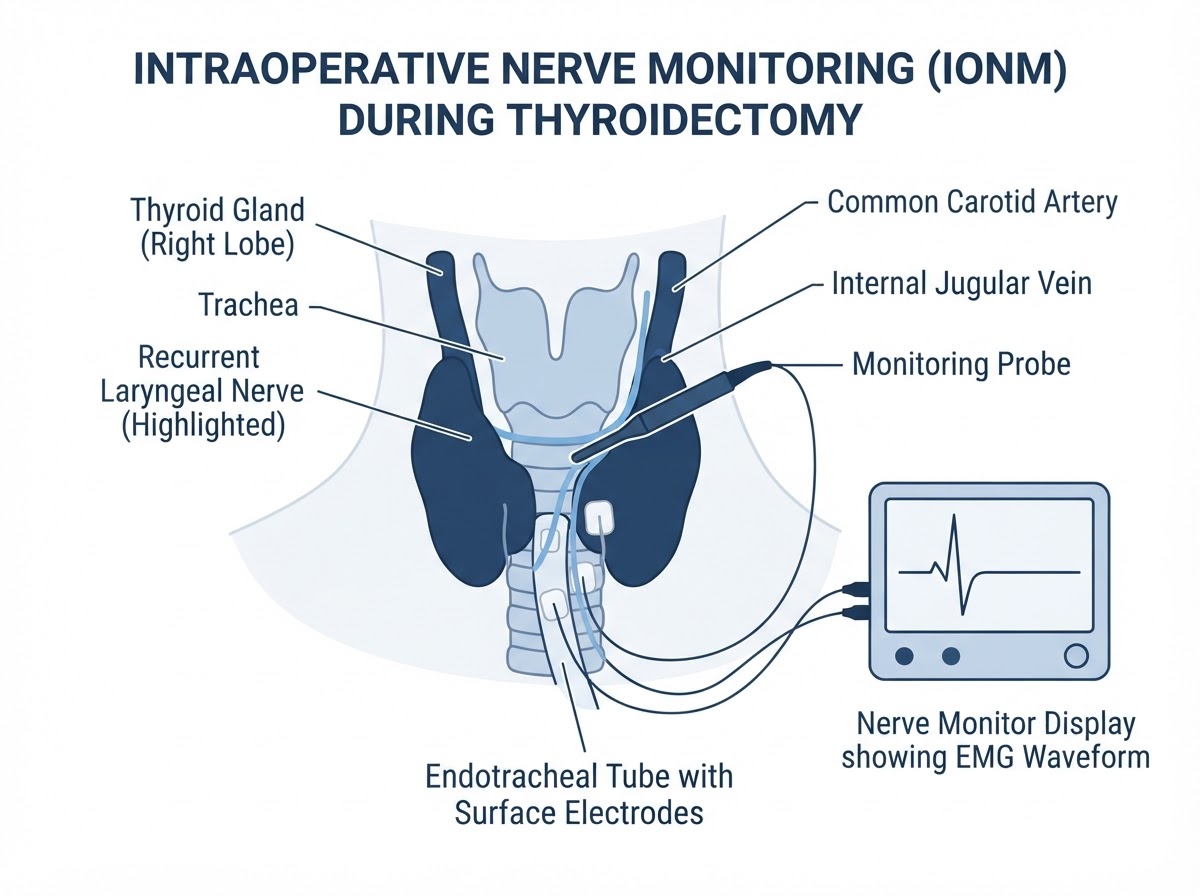
Intraoperative nerve monitoring protects the recurrent laryngeal nerve during thyroidectomy
Thyroid and parathyroid surgeries are performed under general anesthesia in a hospital or specialized surgical center. The specific approach depends on the condition being treated:
Thyroidectomy (Partial or Total)
An incision is carefully placed in a natural skin crease in the lower neck. Dr. Nasser meticulously dissects the Thyroid Gland tissue away from the trachea and surrounding structures. Throughout the procedure, Intraoperative Nerve Monitoring is utilized to continuously track the function of the Recurrent Laryngeal Nerve, significantly reducing the risk of vocal cord injury. The Parathyroid Glands are also identified and preserved to maintain calcium regulation. Depending on the diagnosis, either one lobe (hemithyroidectomy) or the entire gland (total Thyroidectomy) is removed. If cancer has spread, a central or lateral Neck Dissection may also be performed to remove affected lymph nodes.
Parathyroidectomy
For primary Hyperparathyroidism caused by a single adenoma, Dr. Nasser often performs a minimally invasive parathyroidectomy. Using preoperative imaging (such as a Sestamibi scan or high-resolution ultrasound), the exact location of the overactive Parathyroid Glands is identified. A small incision is made, and only the diseased gland is removed. Intraoperative parathyroid hormone (PTH) monitoring may be used; a rapid drop in PTH levels during surgery confirms that the hyperfunctioning tissue has been successfully completely removed.
Recovery Timeline
Recovery varies based on the extent of the surgery, but most patients find the process smoother than anticipated.

Most patients return to normal activities and an active lifestyle within weeks of thyroid surgery
- 1Hospital StayMany patients go home the same day (outpatient), while others stay overnight for observation, particularly to monitor blood calcium levels after a total thyroidectomy.
- 2First Few DaysMild to moderate sore throat (often from the breathing tube used during anesthesia) and neck stiffness are common. Pain is usually well-managed with over-the-counter or prescribed medications. You may eat a normal diet as tolerated.
- 31-2 WeeksMost patients return to work and light daily activities within a week. Strenuous exercise and heavy lifting should be avoided for about two weeks to prevent bleeding and optimize incision healing.
- 4Long-Term ManagementIf you had a total thyroidectomy, you will begin thyroid hormone replacement therapy. Your endocrinologist or primary care physician will check your blood levels approximately 4-6 weeks after surgery to adjust your dosage. Dr. Nasser will monitor your incision healing and any temporary voice changes.
Benefits
- ✓ Definitive treatment for thyroid cancer or suspicious nodules.
- ✓ Relief of compressive symptoms (breathing/swallowing difficulty).
- ✓ Resolution of hyperthyroidism symptoms.
- ✓ Correction of elevated calcium levels and prevention of bone loss (parathyroidectomy).
- ✓ Accurate final pathology diagnosis.
Potential Risks
- • Temporary or permanent voice changes (recurrent laryngeal nerve injury).
- • Temporary or permanent low blood calcium (hypoparathyroidism).
- • Postoperative bleeding (hematoma) requiring intervention.
- • Infection or poor wound healing.
- • Need for lifelong thyroid hormone replacement.
Alternative Treatment Options
Depending on your specific diagnosis, surgery may not be the only option. Dr. Nasser prioritizes shared decision making and will discuss all appropriate alternatives, which may include:
- Active Surveillance: For very small, low-risk papillary thyroid microcarcinomas or stable, benign nodules, close monitoring with regular ultrasounds may be recommended instead of immediate surgery.
- Medical Management: Hyperthyroidism can sometimes be managed with antithyroid medications prescribed by an endocrinologist.
- Radioactive Iodine (RAI): Used for certain types of hyperthyroidism (like Graves' disease) to ablate the overactive gland without surgery. RAI is also frequently used *after* surgery for specific cases of thyroid cancer.
Treatment recommendations are highly individualized based on national guidelines, your specific pathology, and your personal health goals.
Why Patients Choose Dr. Hassan Nasser
Thyroid and parathyroid surgery requires precision, anatomical expertise, and a commitment to preserving vital functions. Patients trust Dr. Nasser because of his:
- Fellowship-Trained Expertise: Specialized training in complex head and neck surgical oncology.
- Routine Use of Nerve Monitoring: Advanced intraoperative technology is utilized in every thyroid and parathyroid surgery to identify and protect the vocal cord nerves.
- Multidisciplinary Collaboration: Dr. Nasser works closely with referring endocrinologists, primary care physicians, and pathologists to ensure comprehensive, coordinated care.
- Patient-Centered Education: A commitment to taking the time to explain diagnoses, review imaging together, and ensure patients feel confident and informed about their surgical plan.
Educational Disclaimer
This content is provided by the practice of Dr. Hassan Nasser for general educational purposes only. It is not a substitute for professional medical advice, diagnosis, or treatment. Always seek the advice of your physician or other qualified health provider with any questions you may have regarding a medical condition. Individual results and recovery vary.
References & Sources
Preparing For Your Consultation
To ensure the most productive evaluation, please prepare the following for your visit:
- Medical Records: Bring any recent ultrasound reports, CT scans, or MRI results of the neck.
- Pathology Reports: If you have had a fine needle aspiration (FNA) biopsy, please bring the official pathology report.
- Lab Results: Recent blood work, specifically TSH, free T4, Calcium, and PTH levels.
- Medication List: A complete list of current medications and supplements.
Frequently Asked Questions
Educational information regarding thyroid and parathyroid procedures.
Expertise in Head & Neck Surgery
If you have been diagnosed with a thyroid nodule, thyroid cancer, or a parathyroid disorder, specialized surgical evaluation is essential. Schedule a consultation with Dr. Hassan Nasser to discuss your evidence-based treatment options.