
Specialized surgical management of tumors affecting the throat and voice box. Serving patients from Wayne County, Macomb County, and across Metro Detroit, Dr. Hassan Nasser utilizes evidence-based oncologic principles to eradicate disease while prioritizing the preservation of breathing, swallowing, and speech functions.
Understanding Throat & Laryngeal Cancer
A diagnosis of throat or laryngeal (voice box) cancer presents unique challenges because these structures are fundamentally tied to how we communicate, eat, and breathe. Tumors in this region require highly specialized, meticulous surgical intervention to ensure the cancer is completely removed while safeguarding a patient’s quality of life.
Surgical management of throat and laryngeal cancers is complex and highly individualized. Dr. Hassan Nasser approaches each case with a commitment to evidence-based oncologic care. By utilizing advanced surgical techniques—including organ-preservation strategies and complex microvascular reconstruction—he strives to achieve clear surgical margins while maintaining or restoring vital functions.
What This Procedure Treats
Throat and laryngeal cancer surgery addresses malignant tumors located in the pharynx (throat) and Larynx (voice box). Common areas of involvement include:
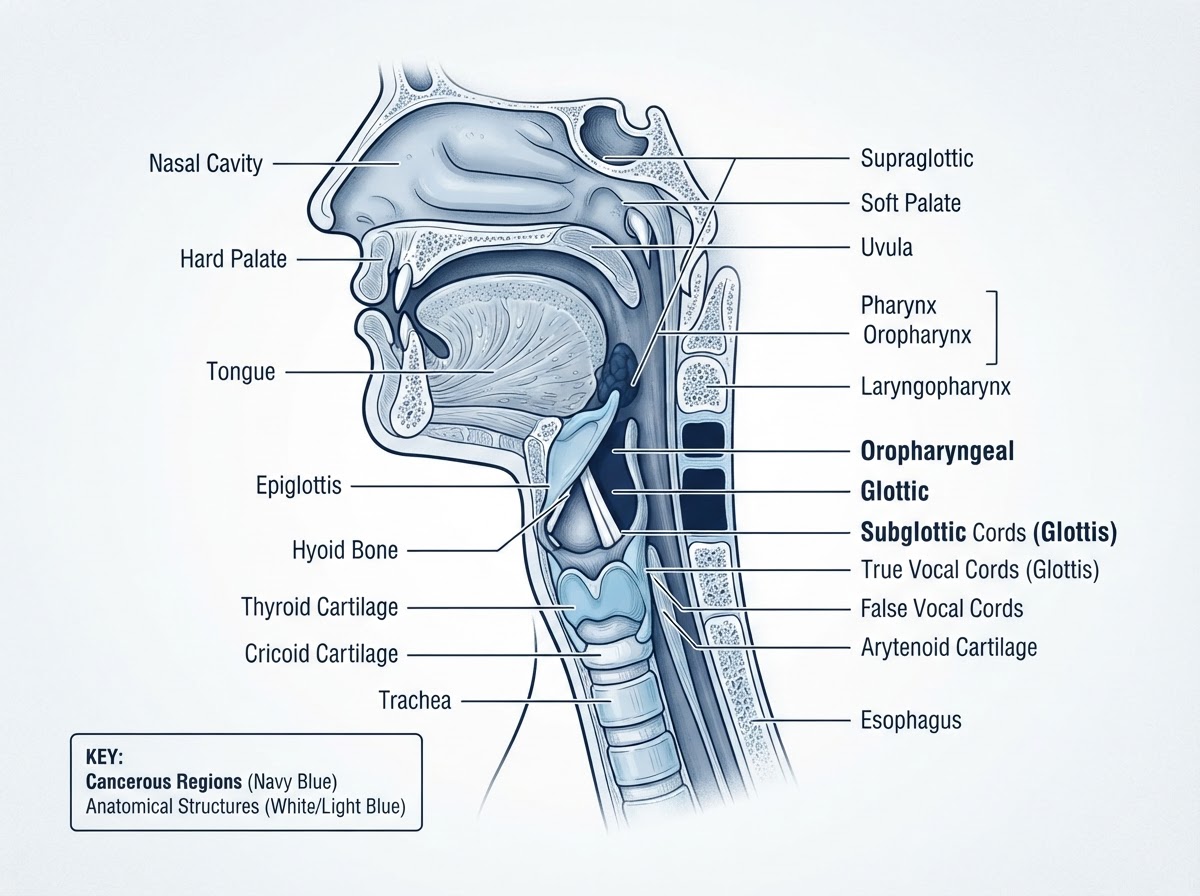
Anatomical regions of the throat and larynx where tumors may develop
- Glottic Cancers: Tumors originating directly on the vocal cords. These often present early due to changes in the voice, such as persistent hoarseness.
- Supraglottic Cancers: Tumors located in the upper portion of the voice box, above the vocal cords, including the epiglottis.
- Subglottic Cancers: Rare tumors located in the lower portion of the voice box, below the vocal cords.
- Oropharyngeal Cancers: Tumors in the middle part of the throat, including the tonsils and the base of the tongue. These are increasingly associated with the Human Papillomavirus (HPV).
- Hypopharyngeal Cancers: Tumors in the lower part of the throat, beside and behind the voice box.
Patients often seek evaluation when they experience a persistent sore throat, chronic hoarseness, difficulty or pain when swallowing, a sensation of a lump in the throat, ear pain, or a noticeable mass in the neck. Early evaluation by a head and neck specialist is critical for accurate diagnosis and effective treatment.
Who is a Good Candidate?
Surgical intervention is a cornerstone of treatment for many throat and laryngeal cancers, but candidacy depends on the specific characteristics of the tumor and the patient. Ideal candidates for surgery generally include individuals who:
- Have a biopsy-confirmed diagnosis of cancer in the throat or larynx.
- Are in sufficient overall health to safely tolerate general anesthesia and the surgical recovery process.
- Have a tumor that can be completely resected with acceptable functional outcomes, or require salvage surgery after previous treatments (such as radiation) have failed.
- Are prepared to engage actively in postoperative rehabilitation, particularly speech and swallowing therapy.
Your Consultation
A comprehensive consultation is the foundation of effective oncologic care. Dr. Nasser prioritizes patient education and shared decision making, ensuring you fully understand your diagnosis and treatment options. During your visit, you can expect:
1. Detailed Examination
Dr. Nasser will conduct a thorough physical examination of your head and neck. This typically includes a flexible laryngoscopy—a brief, minimally invasive procedure using a small camera to directly visualize your throat and vocal cords.
2. Review of Diagnostics
We will review your pathology reports and imaging studies (such as CT scans, MRIs, or PET scans) to accurately stage the disease and determine its exact location and extent.
3. Multidisciplinary Planning
Throat and laryngeal cancers often require a team approach. Dr. Nasser collaborates closely with medical oncologists, radiation oncologists, and specialized speech-language pathologists to formulate a comprehensive, evidence-based treatment plan.
4. Reconstructive and Functional Strategy
If your tumor removal will significantly impact your airway or swallowing mechanism, Dr. Nasser will discuss advanced reconstructive options and voice restoration procedures designed to maximize your postoperative quality of life.
Procedure Overview
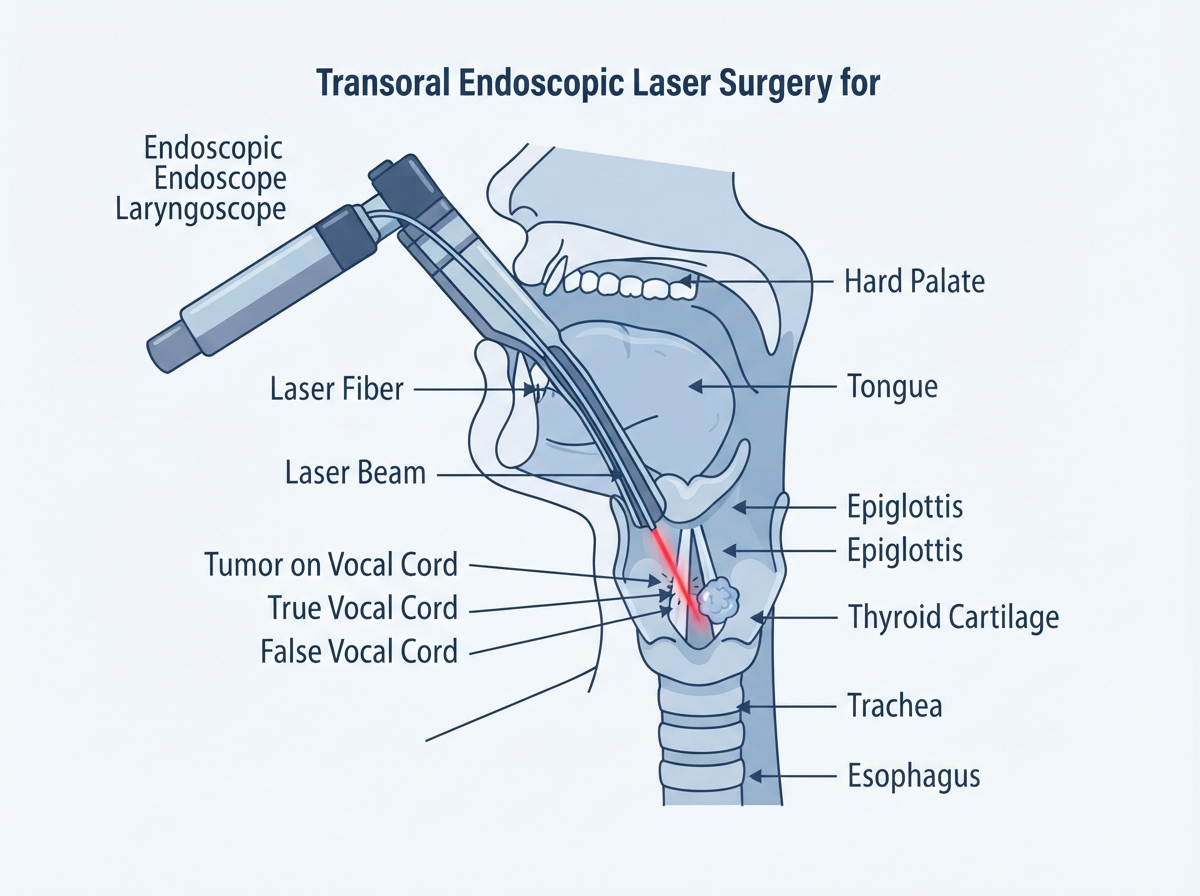
Transoral endoscopic laser surgery for early-stage laryngeal tumors
Throat and laryngeal cancer surgery is performed under general anesthesia. The specific procedure depends entirely on the tumor's size, location, and stage.
Transoral Surgery: For certain early-stage tumors, Dr. Nasser may utilize minimally invasive techniques accessed entirely through the mouth, using specialized instruments or lasers to remove the cancer without external incisions.
Partial Laryngectomy: For tumors that have not spread throughout the entire voice box, a portion of the Larynx may be removed while preserving enough structure to maintain natural breathing and speech.
Total Laryngectomy: For advanced cancers, the entire voice box may need to be removed. In these cases, the airway is surgically separated from the digestive tract, and a permanent breathing opening (stoma) is created in the neck. Advanced voice restoration techniques (such as a TEP) are often performed simultaneously.
Neck Dissection: Because these cancers frequently spread to the lymph nodes in the neck, a Neck Dissection is often performed concurrently to remove these lymph nodes for therapeutic or staging purposes.
Reconstruction: If significant tissue is removed, Dr. Nasser utilizes advanced reconstructive techniques, including microvascular free tissue transfer, to rebuild the throat and restore the ability to swallow.
Recovery Expectations
Recovery following throat or laryngeal cancer surgery is a highly individualized process that depends on the complexity of the resection and reconstruction.

Voice preservation and restoration techniques help many patients communicate confidently after recovery
Hospital Stay: Minimally invasive procedures may require only a brief hospital stay. Complex surgeries involving major resections and Free Flap reconstruction typically involve a 7 to 10-day hospital stay for close monitoring of the airway and reconstructed tissue.
Nutrition and Airway Management: Swelling in the throat is expected. Temporary feeding tubes are frequently utilized to ensure adequate nutrition while the throat heals. In many cases, a temporary tracheostomy is placed to protect the airway until swelling subsides.
Rehabilitation: Healing is a process. Speech and swallowing therapy begins early in the recovery phase. While initial communication and eating may be challenging, most patients experience significant functional improvement over several weeks to months as they adapt to the altered anatomy.
Benefits
- • Complete removal of cancerous tissue with clear margins
- • Accurate pathological staging to guide further treatment
- • Immediate functional reconstruction to preserve swallowing
- • Prevention of tumor progression and local spread
- • Relief from tumor-associated airway obstruction or pain
- • Improved long-term survival rates
Potential Risks
- • General surgical risks (bleeding, infection, anesthesia complications)
- • Temporary or permanent changes to voice quality
- • Difficulty swallowing or need for long-term dietary modifications
- • Requirement for a temporary or permanent breathing stoma
- • Reconstructive flap complications requiring revision
- • Need for postoperative radiation or chemotherapy
Alternative Treatment Options
Treatment recommendations for throat and laryngeal cancers are highly individualized. Alternative or complementary options may include:
- Radiation Therapy: Often used as a primary organ-preservation strategy for early-stage laryngeal cancers to avoid surgery and preserve the natural voice. It may also be used postoperatively to eliminate microscopic disease.
- Chemoradiation: The combination of chemotherapy and radiation therapy is frequently utilized as a primary treatment for advanced throat cancers to preserve the voice box, with surgery reserved for cases where the tumor does not respond or recurs.
- Clinical Trials: Participation in studies evaluating novel immunotherapies or targeted treatment protocols for advanced cancers.
Dr. Nasser participates in multidisciplinary tumor boards to ensure that every patient receives a comprehensive, evidence-based recommendation that considers all available treatment modalities.
The Importance of Early Detection
Early detection of laryngeal cancer significantly improves treatment outcomes. When diagnosed at an early, localized stage, more treatment options are available and outcomes are generally more favorable. Individual prognosis varies based on specific tumor characteristics, patient health, and treatment response. Dr. Nasser will discuss your specific situation during your consultation.
Why Patients Choose Dr. Hassan Nasser
Treating throat and laryngeal cancer requires a delicate balance between aggressive tumor removal and meticulous functional preservation. Dr. Nasser’s specialized fellowship training in Head and Neck Surgical Oncology and Microvascular Reconstruction provides him with the advanced skill set necessary to manage both aspects of care seamlessly.
Patients trust Dr. Nasser because of his commitment to evidence-based medicine, his transparent communication style, and his dedication to individualized treatment planning. He believes in empowering patients through education, ensuring that you and your family are active participants in the decision-making process from the initial consultation through long-term survivorship.
Educational Disclaimer
This content is provided by the practice of Dr. Hassan Nasser for general educational purposes only. It is not a substitute for professional medical advice, diagnosis, or treatment. Always seek the advice of your physician or other qualified health provider with any questions you may have regarding a medical condition. Individual results and recovery vary.
References & Sources
Preparing For Your Consultation
To ensure your visit is comprehensive and efficient, we recommend preparing the following information prior to your appointment:
Medical Records
Please bring physical copies or discs of any recent imaging (CT, MRI, PET) and official pathology reports from previous biopsies.
Medication List
Provide a complete, updated list of all current prescriptions, over-the-counter medications, and supplements you are taking.
Questions to Ask
Write down your questions regarding your diagnosis, the proposed surgical plan, reconstructive options, and the expected recovery timeline.
Support System
We strongly encourage you to bring a trusted family member or friend to help take notes and support you during this important discussion.
Patient Education & Resources
Explore our additional resources to learn more about head and neck surgery, recovery guidelines, and practice information:
Frequently Asked Questions
Key Focus Areas
- Complete tumor resection
- Speech & swallowing preservation
- Voice restoration techniques
- Multidisciplinary care
- Evidence-based protocols
Experience the difference of specialized care.
Contact our office today to schedule your consultation with Dr. Nasser and learn more about throat and laryngeal cancer treatment options.
Contact Us Today