
Expert surgical management of benign and malignant tumors located at the base of the skull. Dr. Hassan Nasser collaborates with leading neurosurgeons to provide safe access, complete tumor removal, and sophisticated functional and aesthetic reconstruction.
Understanding Skull Base Surgery
The skull base is a highly complex and delicate area located at the bottom of the skull, serving as the floor upon which the brain rests. It is a crowded intersection of critical nerves and major blood vessels traveling to and from the brain, face, and neck. When tumors—whether benign or malignant—develop in this region, treating them requires extraordinary precision and a multidisciplinary team approach.
Skull base surgery is a specialized field that combines the expertise of head and neck surgeons (otolaryngologists) and neurosurgeons. Serving patients from Detroit, Ann Arbor, and across Metro Detroit, Dr. Hassan Nasser brings fellowship-trained expertise in advanced head and neck oncology and microvascular reconstruction to these collaborative cases. His role focuses on providing safe surgical access to the tumor through the complex anatomy of the face and sinuses, and crucially, performing the intricate reconstructive procedures necessary to restore function and appearance once the tumor is removed.
Conditions Treated
Skull base surgery is utilized to treat a wide variety of conditions, ranging from benign growths to aggressive malignancies. Common conditions that may require this specialized approach include:
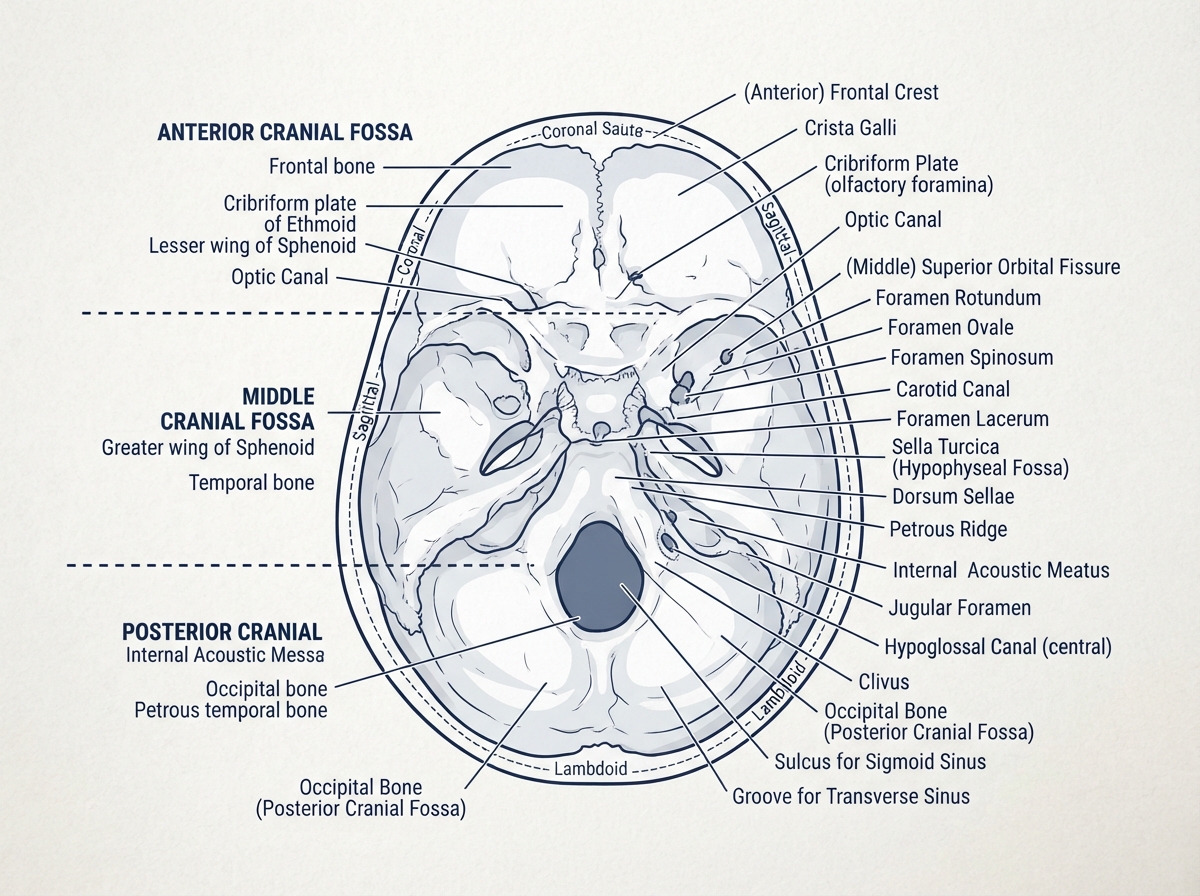
Anatomical view of the skull base regions where tumors may develop
- Acoustic Neuromas (Vestibular Schwannomas): Benign tumors on the nerve leading from the inner ear to the brain, affecting hearing and balance.
- Pituitary Tumors: Growths on the pituitary gland, which can affect hormone production and vision.
- Meningiomas: Typically benign tumors arising from the membranes surrounding the brain and spinal cord.
- Sinonasal Malignancies: Cancers originating in the nasal cavity or paranasal sinuses that extend upward toward the brain.
- Chordomas and Chondrosarcomas: Rare bone cancers that can develop at the base of the skull.
- Cerebrospinal Fluid (CSF) Leaks: Repairing defects in the skull base that allow the fluid surrounding the brain to leak into the nasal cavity.
Who is a Good Candidate?
Candidacy for skull base surgery is determined through a rigorous, multidisciplinary evaluation. Not all tumors in this region require immediate surgery; some may be managed with observation or radiation therapy. Ideal candidates for surgical intervention generally include those who:
- Have a tumor that is causing significant symptoms, such as vision loss, hearing impairment, facial numbness, or severe headaches.
- Have a tumor that is growing rapidly or is proven to be malignant.
- Are in sufficient overall health to safely undergo a prolonged surgical procedure and general anesthesia.
- Have a tumor that can be safely accessed and removed without causing unacceptable neurological deficits.
Your Consultation
Evaluating a skull base tumor is a comprehensive process. During your consultation, Dr. Nasser will carefully review your medical history, symptoms, and previous treatments. The evaluation typically involves:
1. Advanced Imaging Review
High-resolution MRI and CT scans are essential. Dr. Nasser will review these images in detail with you to explain the tumor's exact location, size, and its relationship to critical nerves and blood vessels.
2. Physical and Endoscopic Examination
A thorough examination of the head, neck, and cranial nerves. This often includes a nasal endoscopy to evaluate the nasal cavity and sinuses, which frequently serve as the surgical pathway to the skull base.
3. Multidisciplinary Coordination
Skull base surgery is a team effort. Dr. Nasser works closely with neurosurgeons, radiation oncologists, and medical oncologists. Your case will likely be discussed at a multidisciplinary tumor board to ensure a consensus on the safest and most effective treatment plan.
4. Reconstructive Planning
A critical part of the consultation is discussing how the surgical defect will be repaired. Dr. Nasser will explain the reconstructive options necessary to protect the brain, prevent spinal fluid leaks, and restore facial appearance and function.
Procedure Overview
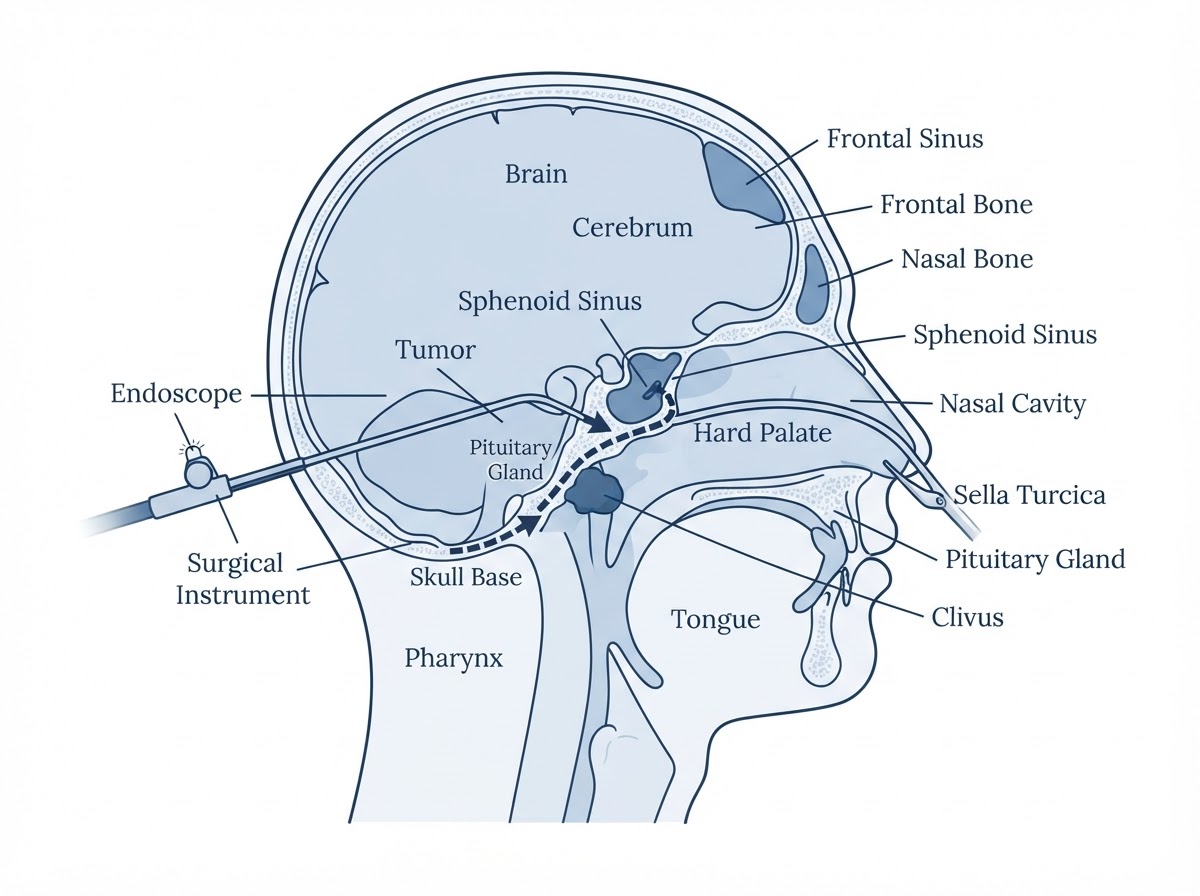
Endoscopic endonasal approach provides minimally invasive access to skull base tumors
Skull base surgery is generally categorized into two main approaches: endoscopic endonasal surgery and open skull base surgery. The choice depends on the tumor's specific characteristics.
Endoscopic Approach (Endonasal): This minimally invasive technique utilizes the natural corridors of the nose and sinuses to reach the Skull Base. Dr. Nasser and a neurosurgeon work together, using specialized endoscopes and instruments to remove the tumor without making external incisions on the face or scalp. This approach typically offers a faster recovery and avoids visible scarring.
Open Skull Base Approach: For larger, more complex tumors, or those located in areas inaccessible through the nose, an open approach may be required. This involves making incisions along the scalp or facial creases to temporarily remove bone and access the tumor.
Reconstruction: Regardless of the approach, once the neurosurgeon has removed the tumor, Dr. Nasser's expertise in reconstruction becomes vital. He utilizes advanced techniques, which may range from Local Flaps (using tissue from inside the nose) to complex Microvascular Reconstruction (moving tissue from another part of the body), to seal the Skull Base, protect the brain, and restore the patient's anatomy.
Recovery Expectations
Recovery from skull base surgery is highly dependent on the surgical approach (endoscopic vs. open) and the extent of the procedure.

Many patients return to full active lifestyles after endoscopic skull base surgery recovery
Hospital Stay: Patients typically spend several days in the hospital. The first day or two are often spent in the Intensive Care Unit (ICU) for close neurological monitoring to ensure there are no complications such as bleeding or cerebrospinal fluid (CSF) leaks.
Healing Timeline: Endoscopic procedures generally involve a shorter recovery, with patients returning to light activities within a few weeks. Open procedures require a longer healing period for the incisions and bone. Fatigue is very common and can persist for several weeks.
Postoperative Care: Frequent follow-up appointments are necessary. If an endoscopic approach was used, Dr. Nasser will perform regular nasal endoscopies in the office to clean the healing sinuses and monitor the reconstructive site. You will be instructed to avoid nose blowing, heavy lifting, and straining to protect the surgical repair.
Benefits
- • Safe removal of complex, deep-seated tumors
- • Relief from neurological symptoms (vision changes, headaches)
- • Prevention of tumor progression and further nerve damage
- • Endoscopic approaches minimize external scarring
- • Advanced reconstruction restores function and appearance
- • Multidisciplinary care optimizes long-term outcomes
Potential Risks
- • Cerebrospinal fluid (CSF) leak requiring further intervention
- • Infection (meningitis)
- • Bleeding or hematoma formation
- • Cranial nerve damage (affecting vision, smell, facial movement, or swallowing)
- • Changes in pituitary gland function (hormonal imbalances)
- • Chronic sinus issues or nasal crusting (with endoscopic approaches)
Alternative Treatment Options
Surgery is not the only option for all skull base tumors. The treatment plan is highly individualized. Alternatives or complementary treatments may include:
- Active Surveillance: For small, asymptomatic, slow-growing benign tumors (like certain acoustic neuromas or meningiomas), careful monitoring with regular MRI scans may be recommended.
- Stereotactic Radiosurgery (e.g., Gamma Knife, CyberKnife): Highly targeted radiation therapy used to halt the growth of certain tumors without traditional surgery. This may be used as a primary treatment or postoperatively for residual tumor.
- Conventional Radiation Therapy or Chemotherapy: Used primarily for malignant tumors, often in combination with surgery.
Why Patients Choose Dr. Hassan Nasser
Skull base surgery demands the highest level of surgical skill and collaboration. Dr. Nasser's fellowship training in advanced head and neck surgical oncology and microvascular reconstruction makes him uniquely qualified to handle the complex access and reconstructive challenges these tumors present.
He is committed to a team-based, multidisciplinary approach, working seamlessly with top neurosurgeons to ensure patient safety and optimal oncologic outcomes. Beyond his technical expertise, Dr. Nasser prioritizes clear, compassionate communication, ensuring that patients and their families are fully educated, supported, and confident throughout the entire treatment and recovery journey.
Educational Disclaimer
This content is provided by the practice of Dr. Hassan Nasser for general educational purposes only. It is not a substitute for professional medical advice, diagnosis, or treatment. Always seek the advice of your physician or other qualified health provider with any questions you may have regarding a medical condition. Individual results and recovery vary.
References & Sources
Preparing For Your Consultation
A skull base surgery consultation is comprehensive. Please arrive prepared with the following to ensure a productive evaluation:
Imaging & Records
It is critical to bring actual copies of your MRI or CT scans on a CD/flash drive, along with the radiologist's reports and any previous operative notes.
Symptom Log
Document your symptoms, including when they started, their frequency, and how they impact your daily life (e.g., vision changes, headaches, hearing loss).
Questions to Ask
Write down your questions regarding the surgical approach, potential risks, reconstructive plans, and the expected recovery process.
Support System
We strongly encourage bringing a trusted family member or friend to help listen to the complex information provided and ask additional questions.
Patient Education & Resources
Explore our additional resources to learn more about related procedures, recovery guidelines, and practice information:
Frequently Asked Questions
Schedule a Consultation
Take the first step toward comprehensive, specialized care. Dr. Nasser provides thorough evaluations and personalized treatment plans for complex skull base tumors.
Request AppointmentPractice Highlights
- Fellowship-trained in Head & Neck Surgical Oncology
- Expertise in complex microvascular reconstruction
- Multidisciplinary, collaborative team approach
- Evidence-based, patient-centered care