
Specialized surgical management of benign and malignant tumors affecting the parotid, submandibular, and minor salivary glands. Dr. Hassan Nasser focuses on complete tumor removal while prioritizing facial nerve preservation and optimal cosmetic outcomes.
Understanding Salivary Gland Tumors
A mass or lump in a salivary gland requires prompt, specialized evaluation. While the majority of these tumors—particularly those in the Parotid Gland—are benign (non-cancerous), they often continue to grow and can eventually compress surrounding structures, including the Facial Nerve.
Surgical management of salivary gland tumors is highly intricate. Serving patients from Detroit, Roseville, and across Metro Detroit, Dr. Hassan Nasser approaches these procedures with a dual focus: utilizing evidence-based oncologic principles to completely remove the tumor, while employing meticulous microsurgical techniques to preserve the Facial Nerve and restore natural facial contours.
What This Procedure Treats
Salivary gland surgery addresses abnormal growths (tumors) originating in the major or minor salivary glands. Common areas of involvement include:
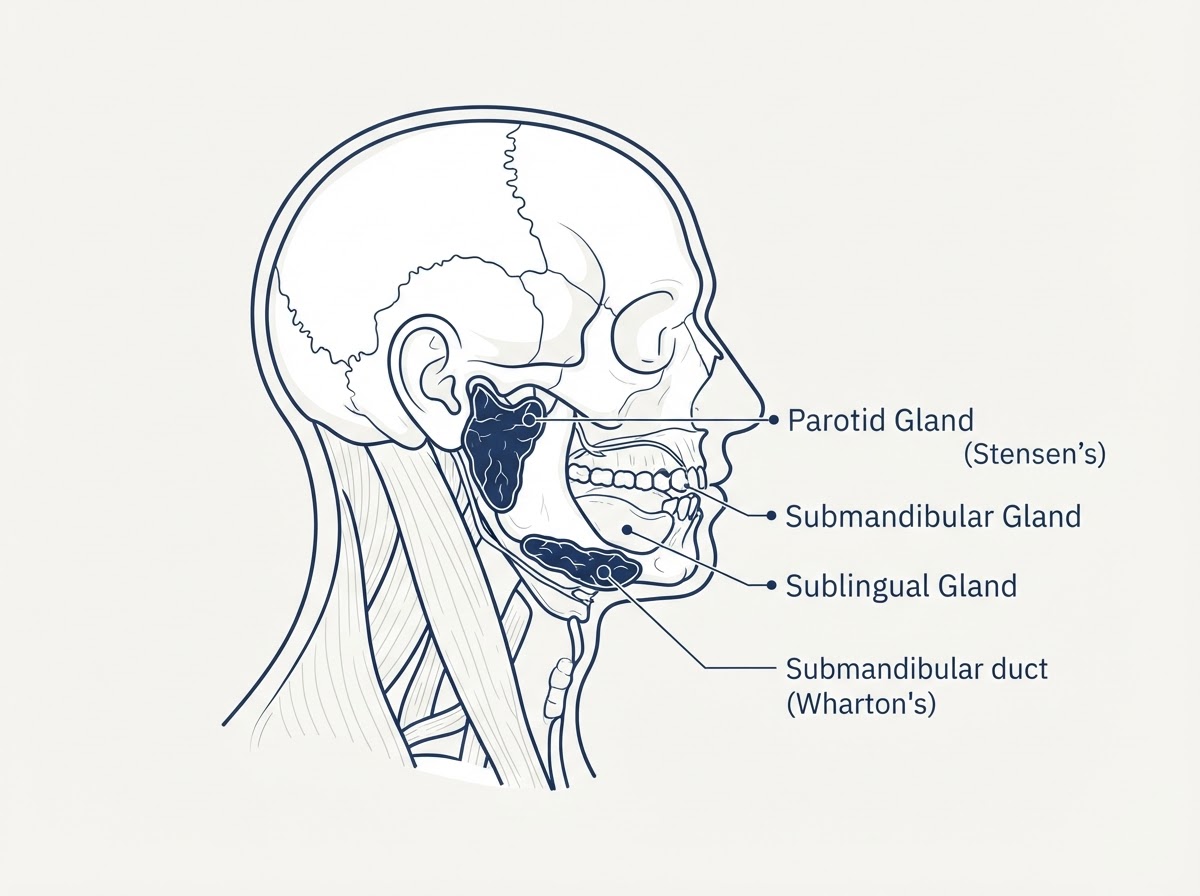
Anatomical view of the major salivary glands where tumors may develop
- Parotid Gland Tumors: The Parotid Glands, located just in front of and below the ears, are the most common site for salivary gland tumors. Most (about 80%) are benign, such as Pleomorphic Adenomas or Warthin's Tumors.
- Submandibular Gland Tumors: The Submandibular Gland, located under the jawbone, tumors here have a higher likelihood of being malignant (cancerous) compared to parotid tumors.
- Sublingual & Minor Salivary Gland Tumors: Tumors located under the tongue or scattered throughout the lining of the mouth and throat. These are rare but are frequently malignant when they occur.
Patients typically seek consultation after noticing a painless, slowly enlarging lump in the cheek, jaw, neck, or mouth. Other concerning symptoms that require immediate evaluation include facial weakness or paralysis, pain in the area of the mass, or difficulty swallowing.
Who is a Good Candidate?
Surgical removal is the primary treatment for nearly all salivary gland tumors, whether benign or malignant. Ideal candidates for surgery generally include individuals who:
- Have a palpable mass or imaging showing a tumor in a salivary gland.
- Have undergone a Fine-Needle Aspiration (FNA) biopsy indicating a benign neoplasm or a malignant tumor.
- Are experiencing symptoms related to tumor growth, such as nerve compression or cosmetic deformity.
- Are in sufficient overall health to safely tolerate general anesthesia and the surgical recovery process.
Your Consultation
A comprehensive consultation is essential to accurately diagnose the tumor and formulate an individualized surgical plan. Dr. Nasser prioritizes patient education, ensuring you understand the nature of your tumor and the specific goals of surgery.
1. Detailed Examination
Dr. Nasser will conduct a thorough physical examination of your head and neck, carefully palpating the mass and performing a comprehensive assessment of your facial nerve function.
2. Review of Diagnostics
We will review your Fine-Needle Aspiration (FNA) biopsy results and advanced imaging studies (such as an MRI or CT scan) to determine the tumor's exact location, its relationship to the Facial Nerve, and whether there is any involvement of surrounding lymph nodes.
3. Surgical Planning
Dr. Nasser will outline the proposed surgical approach, discussing the extent of gland removal required and the techniques that will be utilized to identify and protect the facial nerve.
4. Reconstructive Strategy
To prevent postoperative facial asymmetry (a sunken appearance) and minimize the risk of Frey's syndrome (sweating while eating), Dr. Nasser will discuss concurrent reconstructive techniques, such as a SMAS (Superficial Musculoaponeurotic System) flap or fat grafting.
Procedure Overview
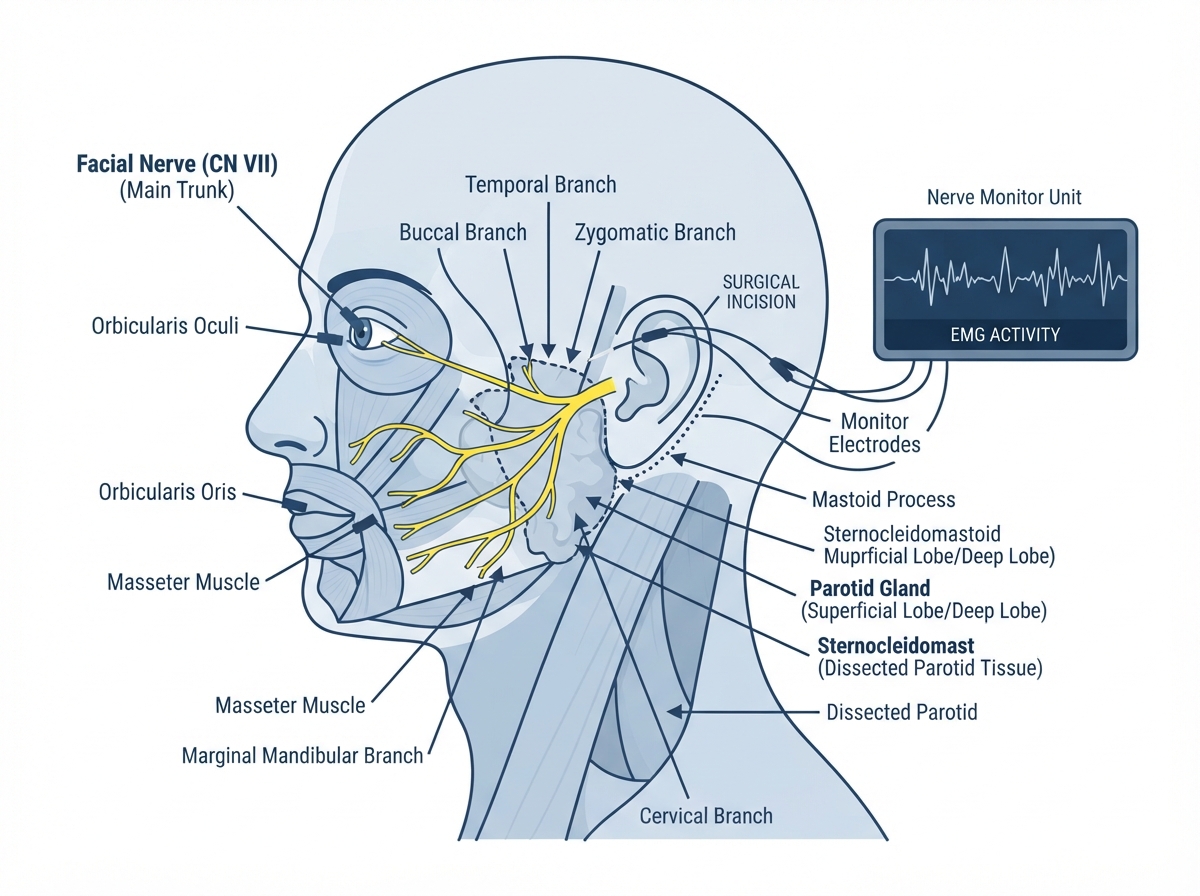
Parotidectomy with continuous intraoperative facial nerve monitoring
Salivary gland surgery is performed under general anesthesia. The specific procedure depends on the tumor's location and whether it is benign or malignant.
Parotidectomy: The most common procedure. Dr. Nasser typically utilizes a modified facelift incision, hiding the scar in the natural creases around the ear. Using continuous Intraoperative Nerve Monitoring and magnification, he meticulously dissects the Facial Nerve away from the tumor. Depending on the tumor's depth, either a superficial Parotidectomy (removing the outer portion of the gland) or a total Parotidectomy is performed.
Submandibular Gland Excision: For tumors under the jaw, an incision is made in a natural skin crease in the upper neck. The entire gland is removed while carefully protecting the nerves that control movement of the lower lip, tongue sensation, and tongue movement.
Neck Dissection: If the tumor is malignant and has spread (or is at high risk of spreading) to the lymph nodes in the neck, a Neck Dissection may be performed simultaneously to remove these lymph nodes.
Immediate Reconstruction: Dr. Nasser frequently performs reconstructive techniques during the same operation to restore facial volume and symmetry, utilizing Local Flaps or free fat transfer.
Recovery Expectations
Recovery following salivary gland surgery is generally well-tolerated, though it requires adherence to postoperative guidelines to ensure optimal healing.

Facial nerve preservation techniques help patients maintain natural expression after recovery
Initial Healing: Most patients go home the same day or after a one-night hospital stay. A small surgical drain may be placed to prevent fluid accumulation and is typically removed within a few days in the office.
Nerve Function: Because the Facial Nerve is manipulated during Parotidectomy, it is common to experience temporary weakness in some facial muscles. This is usually transient, and full function typically returns as the nerve recovers over several weeks to months.
Swelling and Numbness: Mild swelling and bruising around the incision site are expected. Numbness of the earlobe and surrounding skin is very common following parotid surgery and may be permanent, though it generally becomes less noticeable over time.
Activity Restrictions: Patients are typically advised to avoid strenuous activity, heavy lifting, and bending over for 2 to 3 weeks to minimize the risk of bleeding and fluid accumulation.
Benefits
- • Complete removal of the tumor to prevent further growth
- • Accurate pathological diagnosis to guide further care
- • Relief from symptoms such as pain or nerve compression
- • Prevention of benign tumors transforming into malignancies
- • Preservation of facial nerve function and expression
- • Excellent cosmetic outcomes with hidden incisions
Potential Risks
- • General surgical risks (bleeding, infection, anesthesia complications)
- • Temporary or (rarely) permanent facial nerve weakness
- • Numbness of the earlobe or surrounding skin
- • Frey's Syndrome (sweating on the cheek while eating)
- • Salivary fistula (temporary leakage of saliva through the incision)
- • Cosmetic asymmetry or contour deformity
Alternative Treatment Options
For the vast majority of salivary gland tumors, surgical removal is the definitive and recommended treatment. Alternative options are generally limited but may be discussed depending on the specific clinical scenario:
- Active Observation: In very select cases—such as elderly patients with significant medical comorbidities and small, asymptomatic, biopsy-proven benign tumors—a period of close observation with serial imaging may be considered.
- Radiation Therapy: Radiation is not a primary treatment for benign salivary gland tumors. However, it is frequently utilized as an Adjuvant Therapy (postoperative) treatment for malignant tumors to eliminate microscopic disease and reduce the risk of recurrence.
Understanding Salivary Gland Tumors
Salivary gland tumors can occur in the major glands (parotid, submandibular, and sublingual) or in minor salivary glands throughout the mouth and throat. The majority of parotid gland tumors are benign, while tumors in smaller glands have a higher likelihood of malignancy. Accurate diagnosis through fine needle aspiration biopsy and imaging is essential for determining the appropriate surgical approach. Dr. Nasser will discuss your specific diagnosis and treatment options during your consultation.
Why Patients Choose Dr. Hassan Nasser
Salivary gland surgery requires a surgeon with an intimate understanding of complex facial anatomy and the delicate facial nerve. Dr. Nasser’s specialized fellowship training in Head and Neck Surgical Oncology and Facial Plastic and Reconstructive Surgery provides him with the unique expertise to safely remove these tumors while simultaneously addressing the aesthetic reconstruction of the face.
Patients trust Dr. Nasser because of his commitment to evidence-based medicine, his use of advanced intraoperative nerve monitoring, and his transparent communication style. He believes in empowering patients through education, ensuring that you understand your diagnosis and are comfortable with the individualized surgical plan.
Educational Disclaimer
This content is provided by the practice of Dr. Hassan Nasser for general educational purposes only. It is not a substitute for professional medical advice, diagnosis, or treatment. Always seek the advice of your physician or other qualified health provider with any questions you may have regarding a medical condition. Individual results and recovery vary.
References & Sources
Preparing For Your Consultation
To ensure your visit is comprehensive and efficient, we recommend preparing the following information prior to your appointment:
Medical Records
Please bring physical copies or discs of any recent imaging (MRI, CT, Ultrasound) and official pathology reports from previous biopsies.
Medication List
Provide a complete, updated list of all current prescriptions, over-the-counter medications, and supplements you are taking.
Questions to Ask
Write down your questions regarding your diagnosis, the proposed surgical plan, reconstructive options, and the expected recovery timeline.
Support System
We strongly encourage you to bring a trusted family member or friend to help take notes and support you during this important discussion.
Patient Education & Resources
Explore our additional resources to learn more about head and neck surgery, recovery guidelines, and practice information:
Frequently Asked Questions
Schedule a Consultation
If you have been diagnosed with a salivary gland tumor or have a concerning mass in your face or neck, contact our office to schedule a comprehensive evaluation with Dr. Nasser.
Request AppointmentOur team will assist you with gathering necessary records and coordinating your visit.
Why Specialized Care?
Salivary gland surgery requires navigating complex anatomy, particularly the facial nerve. Evaluation by a fellowship-trained Head & Neck Surgeon ensures that both oncologic eradication and functional preservation are prioritized.